
Concawe Review
Concawe Reviews
Technology scouting—carbon capture: from today’s to novel technologies (Concawe Review 29.2)
Concawe has commissioned a new study to evaluate state-of-the-art carbon capture and storage (CCS) technologies, with a focus on commercial/near-term opportunities for CCS that are already in the mark...
Concawe Reviews
A Clean Planet for all: an impact assessment of the potential implications for the refining system and the link with ‘Refinery 2050’ (Concawe Review 29.2)
Focusing on three of the scenarios defined in the European Commission’s long-term strategy, A Clean Planet for all, Concawe has published a report that assesses the potential reductions in CO2 emiss...
Concawe Reviews
JEC Well-to-Wheels study version 5: a look into the carbon intensity of different fuel/powertrain combinations in 2030 (Concawe Review 29.2)
Version 5 of the JEC evaluation of well-to-wheels energy use and greenhouse gas emissions for a range of potential future fuel and powertrain options has now been completed.
Full details are avail...
Concawe Reviews
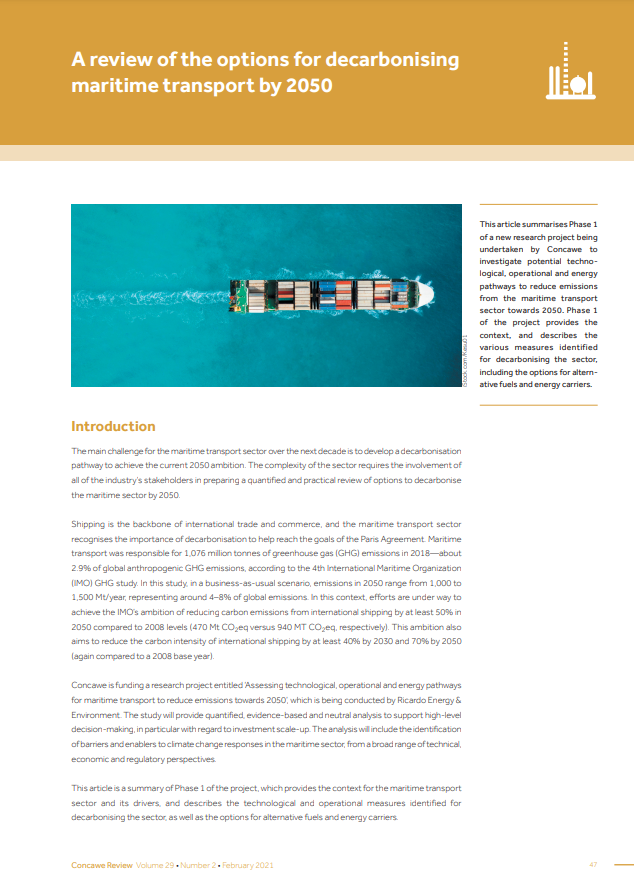
A review of the options for decarbonising maritime transport by 2050 (Concawe Review 29.2)
This article summarises Phase 1 of a new research project being undertaken by Concawe to investigate potential technological, operational and energy pathways to reduce emissions from the maritime tran...
Concawe Reviews
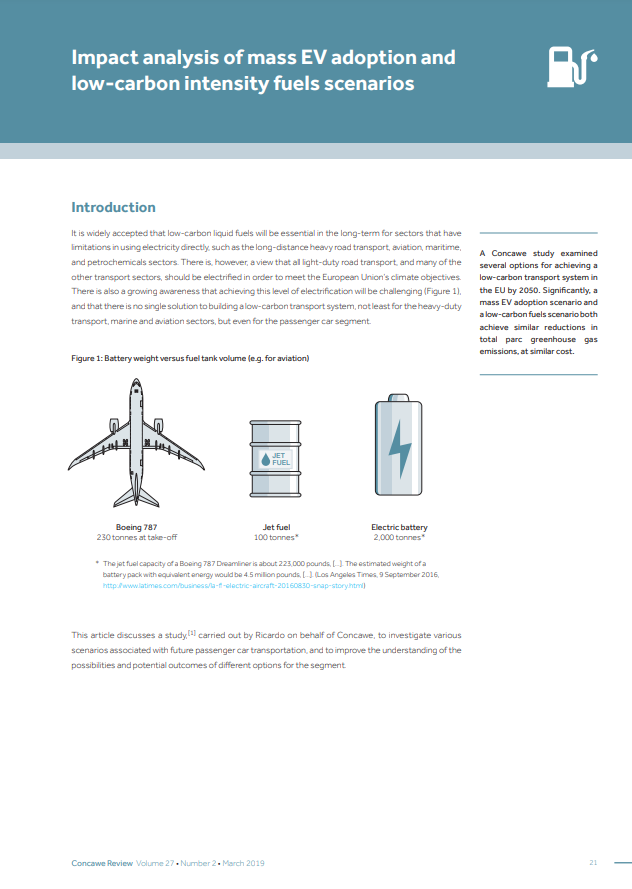
Impact analysis of mass EV adoption and low-carbon intensity fuels scenarios (Concawe Review 27.2)
A Concawe study examined several options for achieving a low-carbon transport system in the EU by 2050. Significantly, a mass EV adoption scenario and a low-carbon fuels scenario both achieve similar...
Concawe Reviews
High-octane petrol (HOP) study: making gasoline relevant for the future of road transport (Concawe Review 28.1)
Improvements in vehicle efficiency will be a key factor in ensuring that liquid fuels remain a vital partner in the future of road transport.
This article looks at the role of high-octane petrol (...
Concawe Reviews
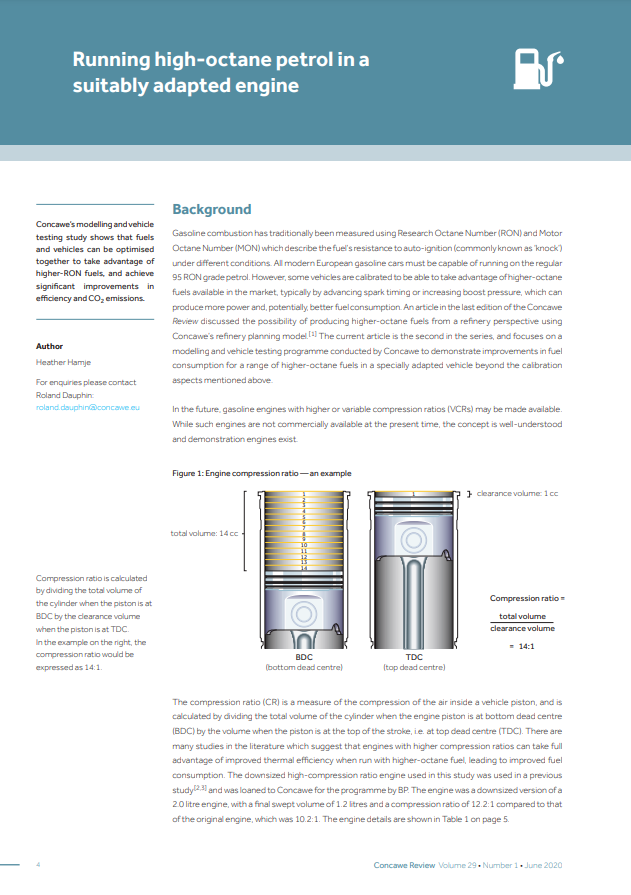
Running high-octane petrol in a suitably adapted engine (Concawe Review 29.1)
Concawe’s modelling and vehicle testing study shows that fuels and vehicles can be optimised together to take advantage of higher-RON fuels, and achieve significant improvements in efficiency and CO...
Concawe Reviews
Exploring possible pathways for the EU refining system to contribute to a low-CO2 economy in the 2030–2050 time frame (Concawe Review 29.1)
This article summarises the results of two Concawe studies which address the potential for refineries to contribute to a future low-carbon economy. Full details of the studies are presented in Concawe...
Concawe Reviews
Exploring possible pathways for the EU refining system to contribute to a low-CO2 economy 29 in the 2030–2050 time frame (Concawe Review 29.1)
This article summarises the results of two Concawe studies which address the potential for refineries to contribute to a future low-carbon economy. Full details of the studies are presented in Concawe...
Concawe Reviews
Understanding the process of setting air quality limit values and the associated compliance challenge
A Concawe modelling study examines how annual average PM and NO2 concentrations would vary under different emission reduction scenarios, and assesses the cost and practicability of achieving complianc...
Concawe Reviews
Running high-octane petrol in suitably adapted engine (Concawe Review 29.1)
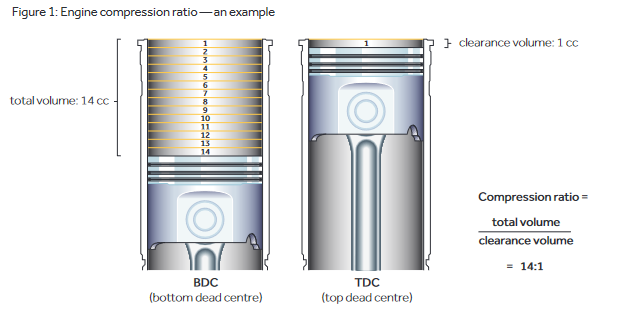
Gasoline combustion has traditionally been measured using Research Octane Number (RON) and Motor Octane Number (MON) which describe the fuel’s resistance to auto-ignition (commonly known as ‘knock...
Concawe Reviews
Concawe Review 29.1
As the first 2020 edition of the Concawe Review is being published, it has been reported in the news that spring has been abnormally warm in EU countries, providing further evidence of climate change....
Concawe Reviews
High-octane petrol (HOP) study: making gasoline relevant for the future of transport
Gasoline is a complex mixture of hydrocarbons and other chemical compounds used as fuel for spark-ignition internal combustion engines (ICEs), primarily in passenger cars and other light-duty transpor...
Concawe Reviews
Outlook for battery raw materials (Concawe Review 28.1)
Recognising that climate change represents an urgent threat to societies and the planet, the 2015 Paris Agreement set the goal of keeping global warming well below 2°C above pre-industrial levels and...
Concawe Reviews
A look into the role of e-fuels in the transport system in Europe (2030–2050) (Concawe Review 28.1)
In December 2015, Parties to the United Nations Framework Convention on Climate Change convened in Paris for the 21st Conference of Parties (COP21). The conference was an important step towards addres...
Concawe Reviews
Concawe Review 28.1
The three articles present in this edition of the Concawe Review emanate from Concawe’s Low Carbon Pathways project. The first article is a literature review summarising different perspectives on e-...
Concawe Reviews
Concawe Review Special Symposium 2019
This special review includes the synopses of the presentations from the Concawe Symposium. The event, which took place in March 2019, focused on the long-term evolution of the refining industry and th...
Concawe Reviews
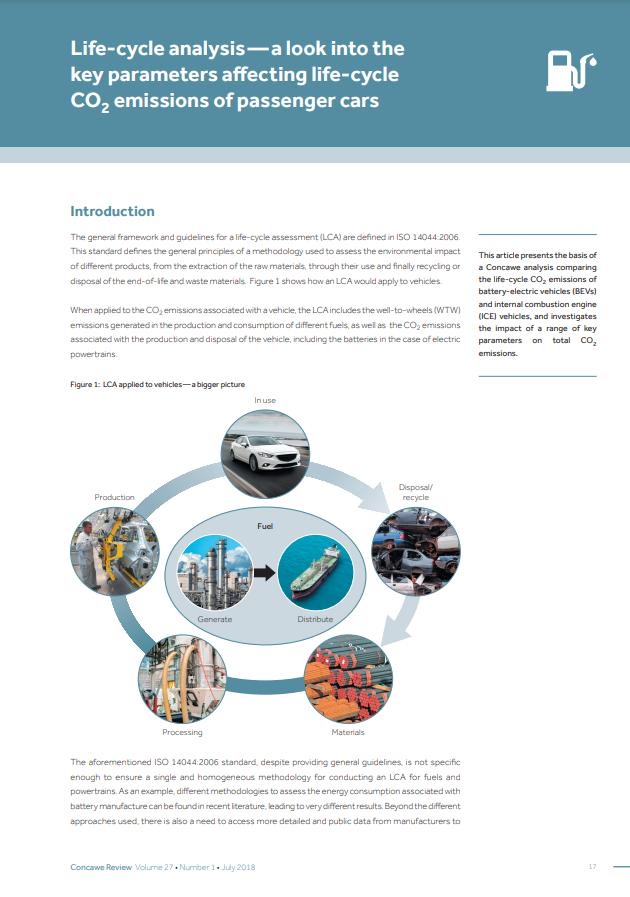
Life-cycle analysis—a look into the key parameters affecting life-cycle CO2 emissions of passenger cars (Concawe Review 27.1)
This article presents the basis of a Concawe analysis comparing the life-cycle CO2 missions of battery-electric vehicles (BEVs) and internal combustion engine (ICE) vehicles, and investigates the impa...
Concawe Reviews
A look into the maximum potential availability and demand for low-carbon feedstocks/fuels in Europe (2020–2050) (literature review) (Concawe Review 27.2)
In light of the EU’s ambitious targets for achieving a low-carbon economy by 2030, Concawe has completed a study of the long-term availability of low-carbon feedstocks and fuels, and the associated...
Concawe Reviews
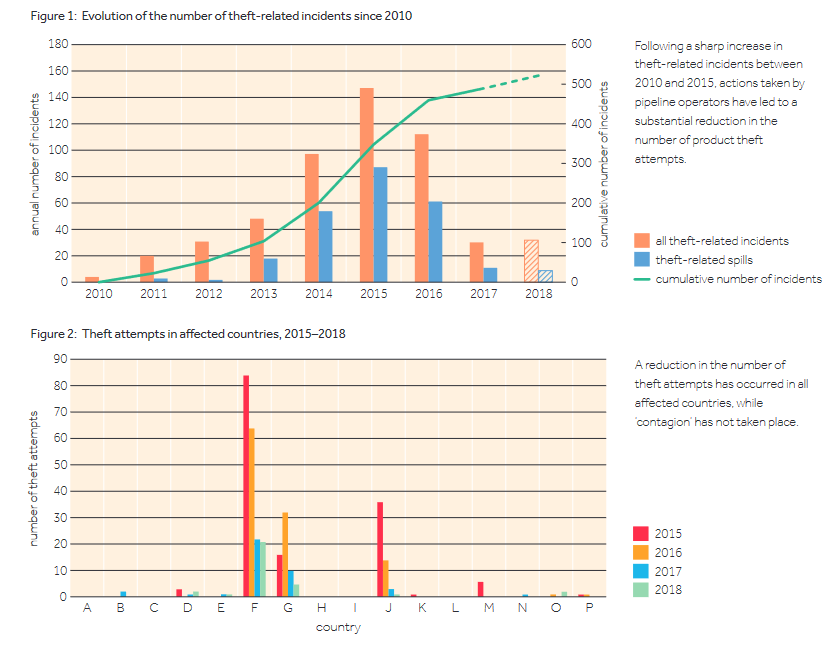
Successfully limiting product theft from European oil pipelines
Oil pipelines typically run over long distances across farmland and open countryside. They are therefore vulnerable to both accidental and malicious interference by third parties. For many years, ille...
Concawe Reviews
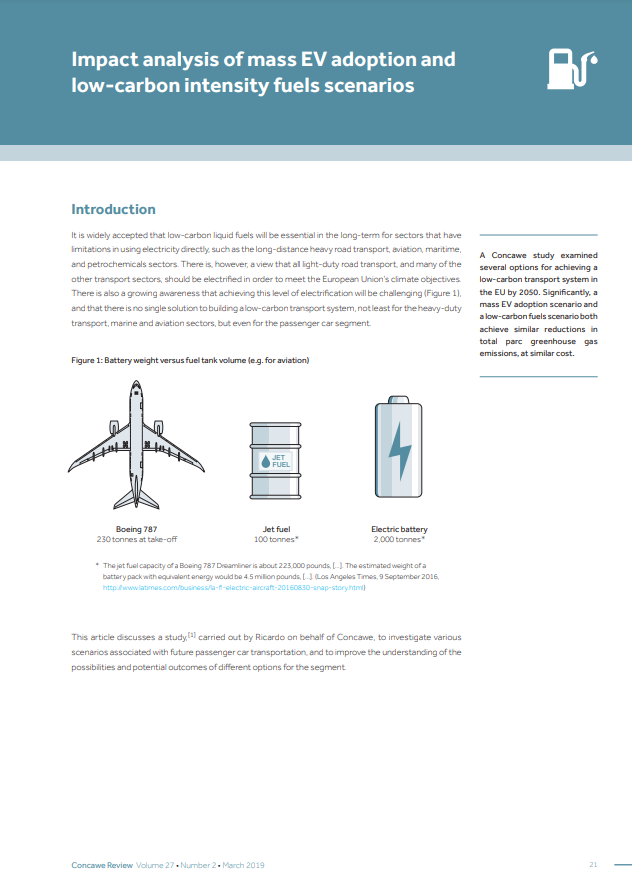
Impact analysis of mass EV adoption and low-carbon intensity fuels scenarios (Review Article)
A Concawe study examined several options for achieving a low-carbon transport system in the EU by 2050. Significantly, a mass EV adoption scenario and a low-carbon fuels scenario both achieve similar...
Concawe Reviews
A look into the maximum potential availability and demand for low-carbon feedstocks/fuels in Europe (2020–2050) (literature review)
In light of the EU’s ambitious targets for achieving a low-carbon economy by 2030, Concawe has completed a study of the long-term availability of low-carbon feedstocks and fuels, and the associated...
Concawe Reviews
Concawe Review 27.2
We are very pleased to introduce the three articles in this edition of the Concawe Review. The first two emanate from Concawe’s Low Carbon Pathways programme. The first article is a literature revie...
Concawe Reviews
The importance of carbon capture and storage technology in European refineries (Concawe Review 27.1)
This article describes the importance of carbon capture and storage (CCS) in meeting future emission targets.
It presents an evaluation of the costs of retrofitting CCS technology in a range of ex...