
Concawe Review
Concawe Reviews
Abating fugitive VOC emissions more efficiently
This article summarizes the Concawe study, ‘Techniques for detecting and quantifying fugitive emissions—results of comparative field studies’, that compares the two BAT (best available technique...

Concawe Reviews
Concawe Review 24.1
The articles in this Concawe Review describes on ongoing work by Concawe to further contribute to the safety of everyone working in our industry, to improve the environmental performance in the manufa...
Concawe Reviews
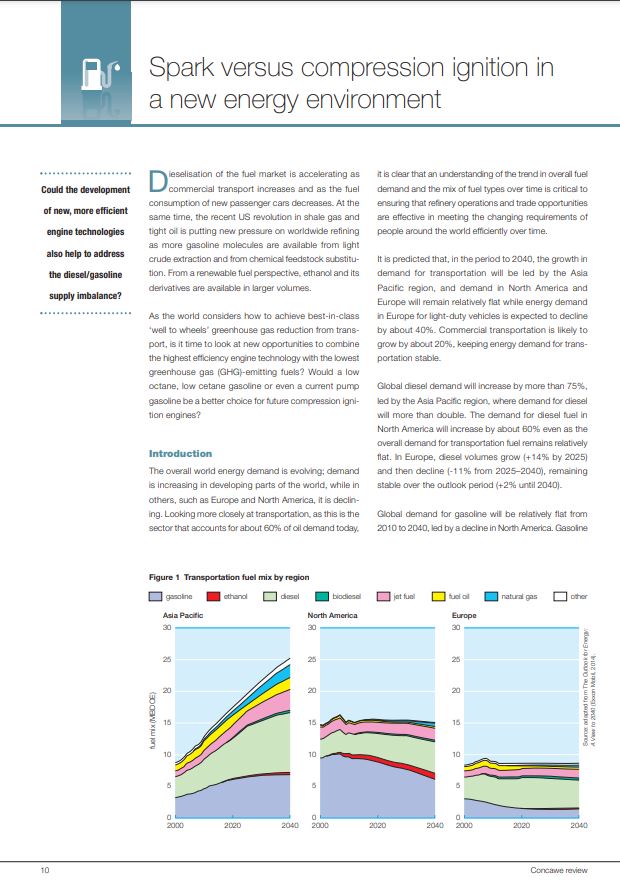
Spark versus compression ignition in a new energy environment
Dieselisation of the fuel market is accelerating as commercial transport increases and as the fuel consumption of new passenger cars decreases. At the same time, the recent US revolution in shale gas...
Concawe Reviews
CONCAWE Review – Year of air 2014 (special issue)
The Thematic Strategy on Air Pollution (2005) has been under review since 2011 with the first of five stakeholder meetings taking place in January 2012. The underpinning work is very complex and rel...
Concawe Reviews
CONCAWE Review – Spring 2014
As the world’s population moves towards 9 billion, societal expectation is that we find solutions to the fundamental problems of meeting increasing energy requirements whilst reducing the impact on...
Concawe Reviews
CBA under the microscope
Concawe Comments on the Key Submissions Associated with 5th Stakeholder Expert Group of the Air Quality Policy Review held in Brussels, 3rd April 2013
Concawe Reviews
Concentration Response Functions for Morbidity Endpoints under the Project HRAPIE
A review of the concentration response functions for morbidity endpoints under the HRAPIE project was conducted.
Concawe Reviews
CBA under the microscope
CONCAWE’s assessment of latest scientific information on valuation of benefits from aspects influencing mortality and morbidity factors reveals that proposed benefit numbers applied in recent Cost B...
Concawe Reviews
Ecosystem services under the microscope
Ecosystem approaches can be defined as ’approaches to environmental management and policy making that aim to compare costs and benefits of management and policy options on the basis of an analysis o...
Concawe Reviews
Science and Policy interface: role of integrated assessment modelling (IAM) and cost-benefit analysis (CBA)
Integrated Assessment Modelling (IAM) has been at the heart of European air quality policy development for more than two decades3. Such tools provide a useful framework for policy makers to connect th...
Concawe Reviews
Uncertainties under the microscope
This section is a summary of a paper prepared by CONCAWE as a contribution to the 4th meeting of the Stakeholder Expert Group on the EU Air Policy review. The study is based on the results of extensiv...
Concawe Reviews
Air quality and health: looking ahead
Evolving scientific insights over the past twenty years. The past twenty years have seen major changes in the techniques and findings of studies on air pollution and health, changes which set today’...
Concawe Reviews
Developments in EU refining: looking ahead to 2020 and beyond
Developments in EU refining: looking ahead to 2020 and beyond Oil refineries are constantly adapting to changes in product quality legislation and market demand. This requires the industry to be a...
Concawe Reviews
Evaluating energy pathways: from well to wheels
Over the past decade, the JEC Research Consortium1 has been working together to better understand the complex issues associated with future vehicles and fuels. While some of this work has involvedÂ...
Concawe Reviews
Forward-looking perspective on oil and gas production in Europe
In 2010 world energy demand was equivalent to about 260 million barrels of oil equivalent per day (boepd), and oil and gas represented 54% of this global demand. According to the International Ener...
Concawe Reviews
Petrochemical feedstocks: the cornerstone of competitiveness
Future outlookThe future of much of Europe’s chemical industry depends heavily upon the availability of affordable petrochemical feedstocks. In the Middle East, where petrochemical feedstocks areÂ...
Concawe Reviews
Petroleum products and REACH: looking ahead
The petroleum refining industry successfully met the first REACH deadline in December 2010 with the registration of all petroleum substances. This was a commendable achievement in view of the complexi...
Concawe Reviews
Renewable fuels: looking ahead to 2020
Increasing renewable energy and reducing GHG emissions from transport It is widely recognised that mobility and transport are fundamental to satisfy socio-economic needs and curbing mobility is no...
Concawe Reviews
The future of water quality management for the refining industry
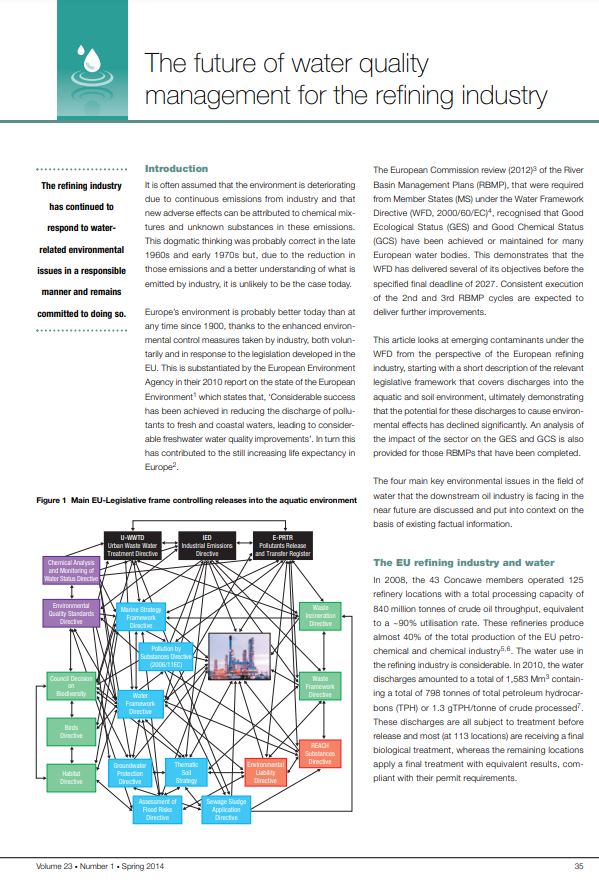
IntroductionIt is often assumed that the environment is deteriorating due to continuous emissions from industry and that new adverse effects can be attributed to chemical mixtures and unknown subst...
Concawe Reviews
Transportation and fuels: looking ahead at aviation
After more than a century since the Wright Brothers took off, we have become accustomed to the conveniences and inconveniences of air transportation. As high speed rail and slower options, like lon...
Concawe Reviews
Transportation and fuels: looking ahead at heavy-duty vehicles
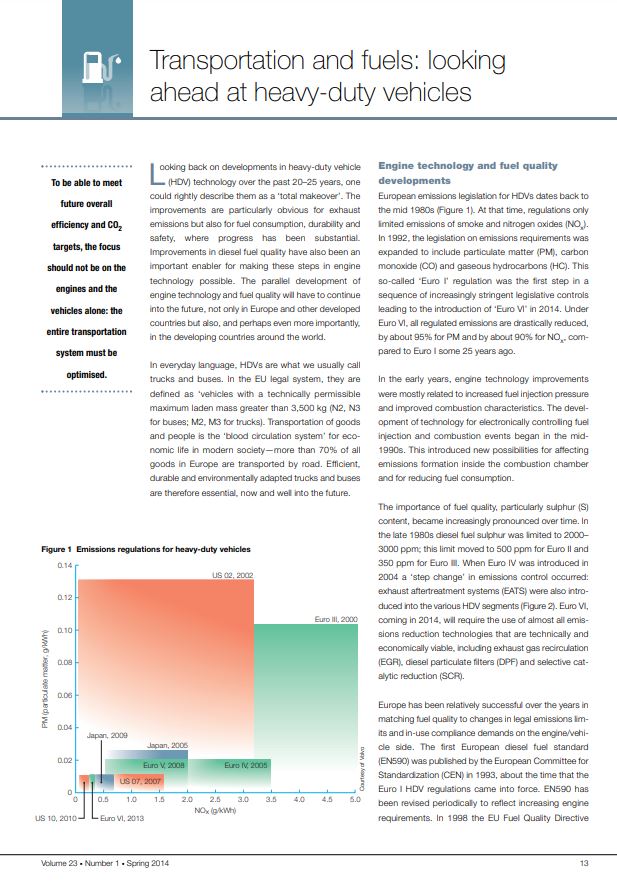
Looking back on developments in heavy-duty vehicle (HDV) technology over the past 20–25 years, one could rightly describe them as a ‘total makeover’. The improvements are particularly obvious...
Concawe Reviews
Transportation and fuels: looking ahead at the future of marine fuels
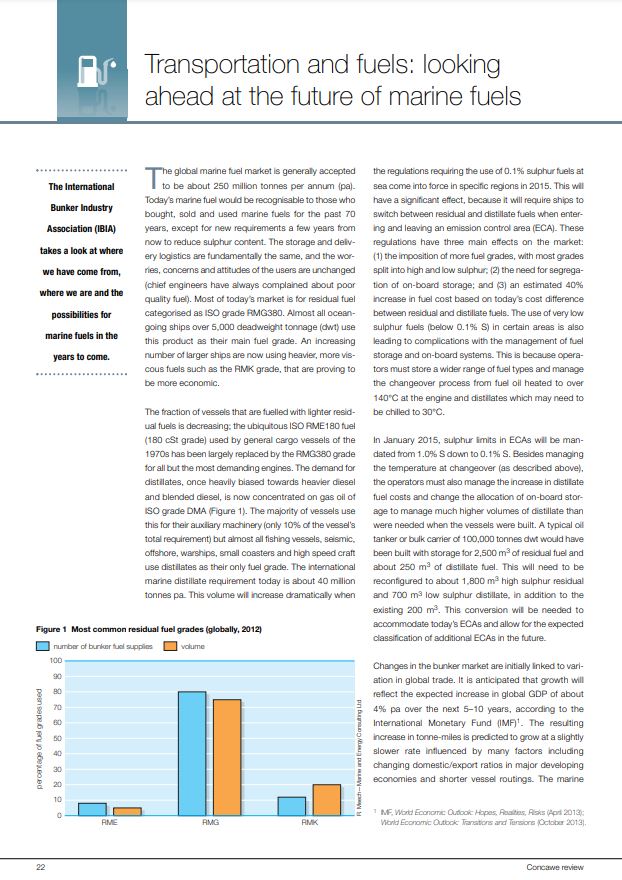
The global marine fuel market is generally accepted to be about 250 million tonnes per annum (pa). Today’s marine fuel would be recognisable to those who bought, sold and used marine fuels for th...
Concawe Reviews
Well-to-Wheels analysis of future automotive fuels and powertrains in the European context
This is a joint study by EUCAR / JRC / CONCAWE. Study Objectives:
Establish, in a transparent and objective manner, a consensual well-to-wheels energy use and GHG emissions assessment of a wide...
Concawe Reviews
CONCAWE Review – Spring 2013
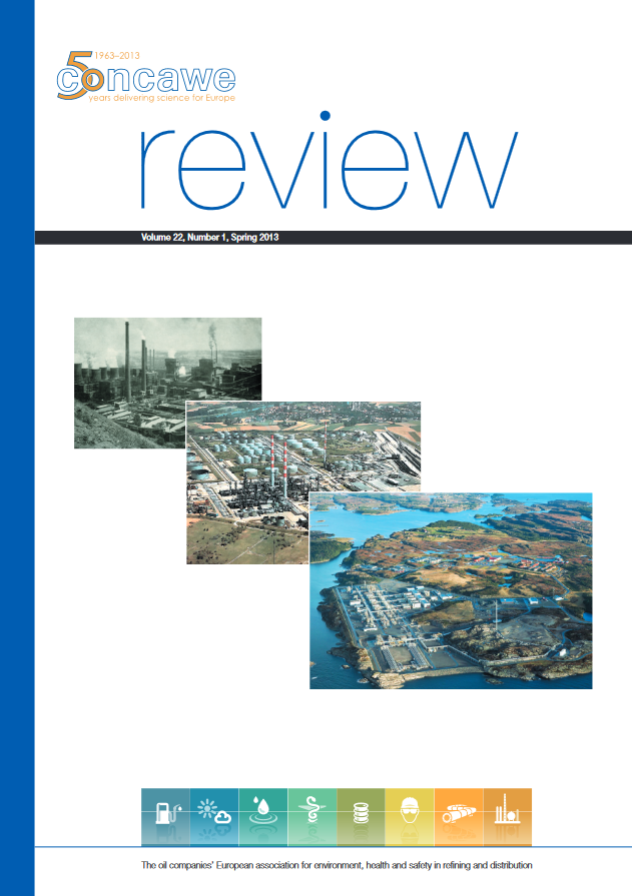
Fifty years ago—in October 1963—six international oil companies operating European refineries decided to form a new Study Group. The objective of this Study Group was to assist the oil companies...