
Concawe Review
Concawe Reviews
Health
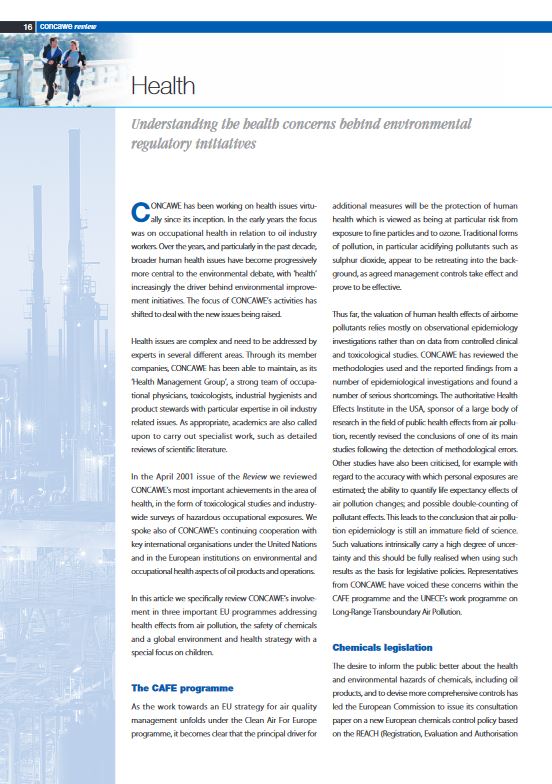
CONCAWE has been working on health issues virtually since its inception. In the early years the focus was on occupational health in relation to oil industry workers.
Over the years, and particul...
Concawe Reviews
Oil pipelines
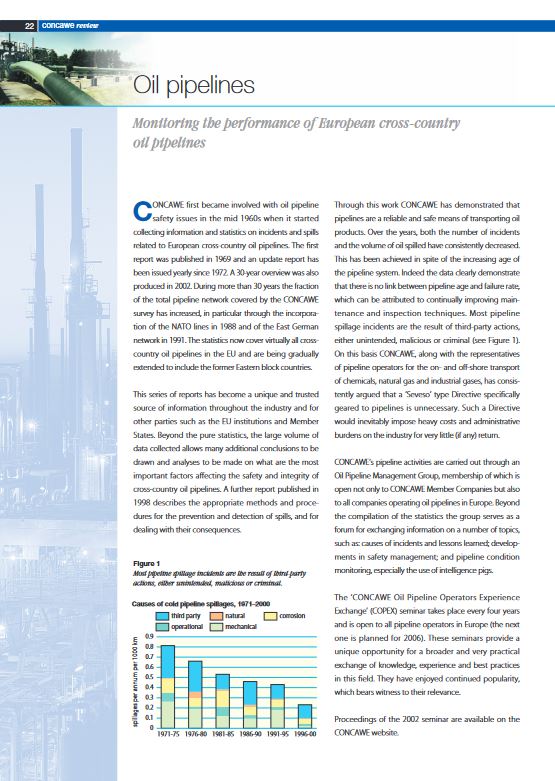
CONCAWE first became involved with oil pipeline safety issues in the mid 1960s when it started collecting information and statistics on incidents and spills related to European cross-country oil pi...
Concawe Reviews
Safety
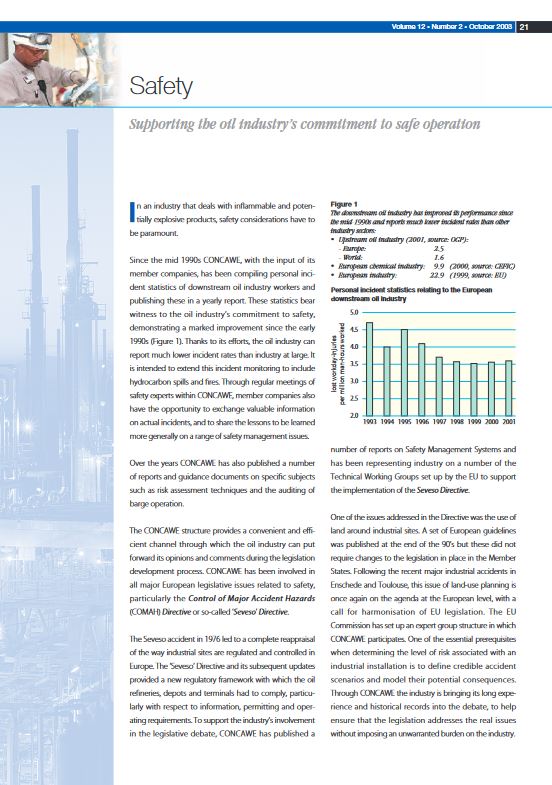
In an industry that deals with inflammable and potentially explosive products, safety considerations have to be paramount. Since the mid 1990s CONCAWE, with the input of its member companies, has b...
Concawe Reviews
Water and waste
Water is an essential resource that has, over the years, come progressively higher on the international agenda because of its intimate relationship with both human health and ecosystem development....
Concawe Reviews
CONCAWE Review – Spring 2003
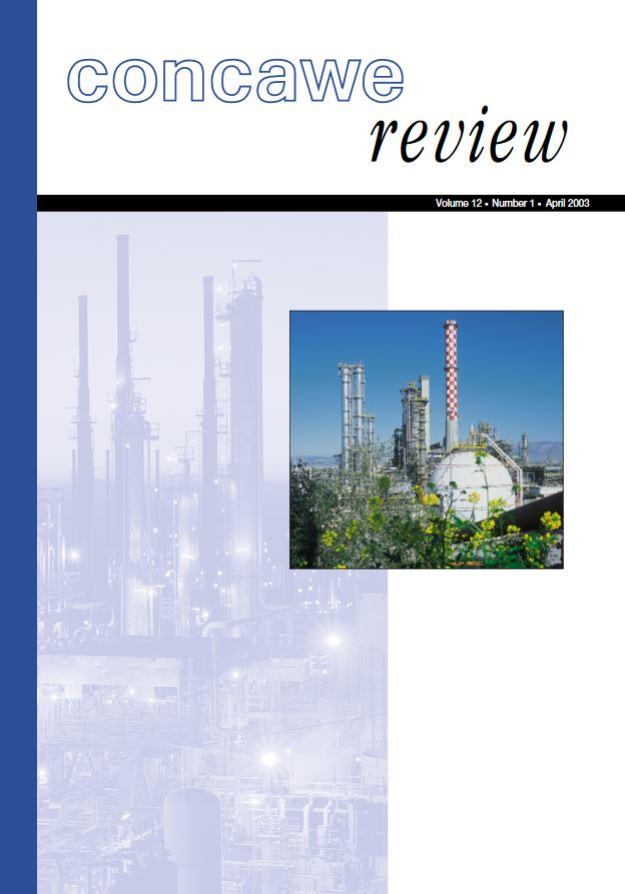
Volume 12 • Number 1: With Europe at the forefront of the ratification of the Kyoto protocol, CO2 and, more generally, greenhouse gases (GHG) are now definitely in the limelight and will be a ce...
Concawe Reviews
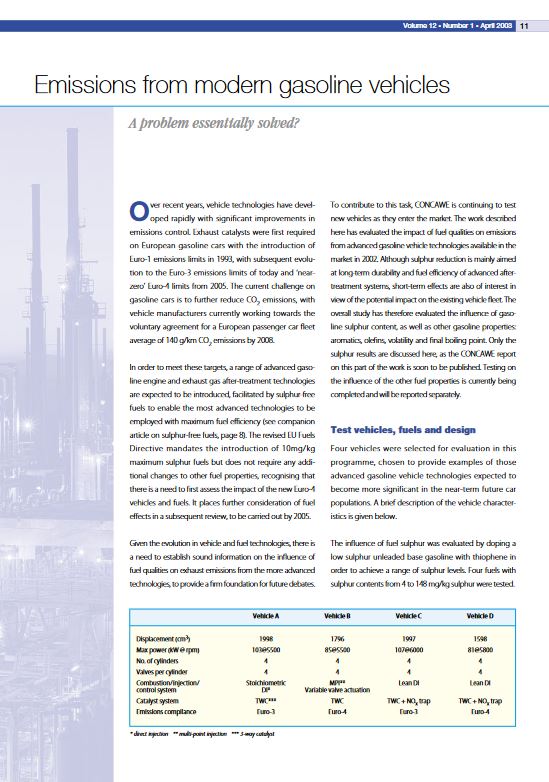
Emissions from modern gasoline vehicles
Over recent years, vehicle technologies have developed rapidly with significant improvements in emissions control. Exhaust catalysts were first required on European gasoline cars with the introduction...
Concawe Reviews
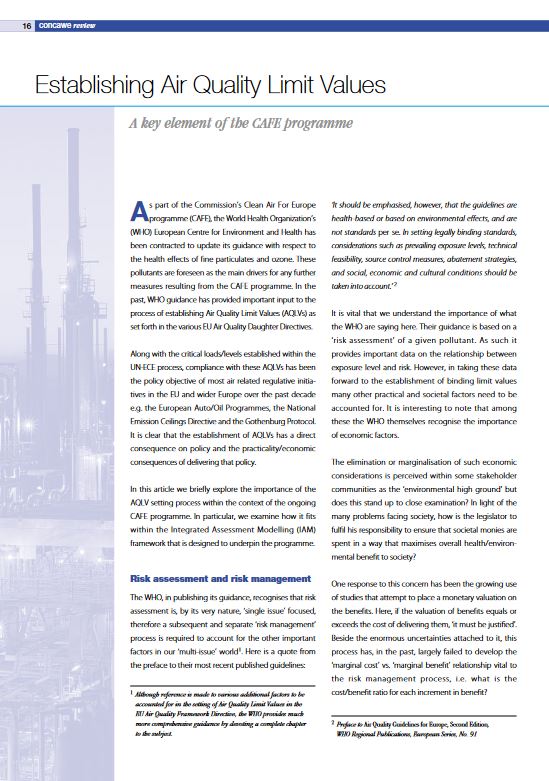
Establishing Air Quality Limit Values
As part of the Commission’s Clean Air For Europeprogramme (CAFE), the World Health Organization’s (WHO) European Centre for Environment and Health has been contracted to update its guidance with...
Concawe Reviews
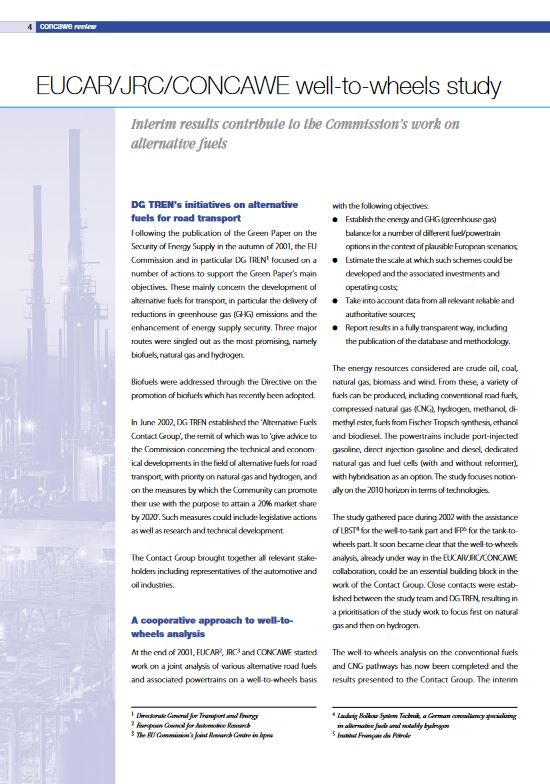
EUCAR/JRC/CONCAWE well-to-wheels study
DG TREN’s initiatives on alternative fuels for road transport Following the publication of the Green Paper on the Security of Energy Supply in the autumn of 2001, the EU Commission and in particular...
Concawe Reviews
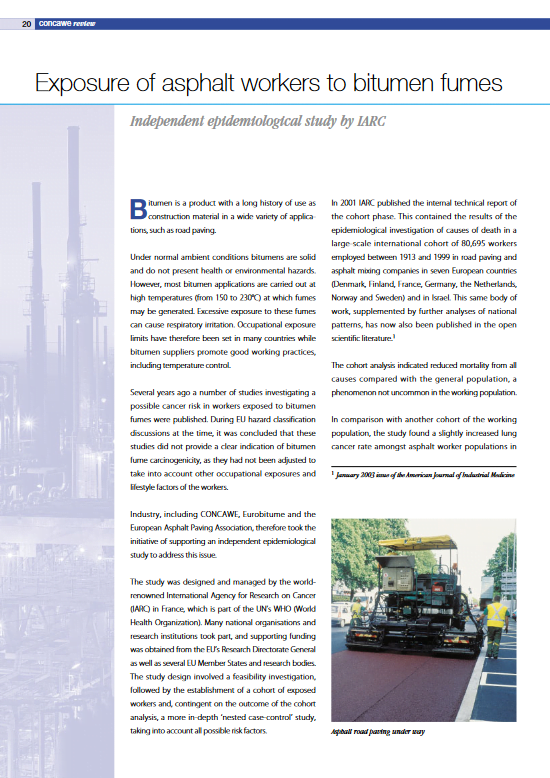
Exposure of asphalt workers to bitumen fumes
Bitumen is a product with a long history of use as construction material in a wide variety of applications, such as road paving. Under normal ambient conditions bitumens are solid and do not presen...
Concawe Reviews
Modelling the European refining industry
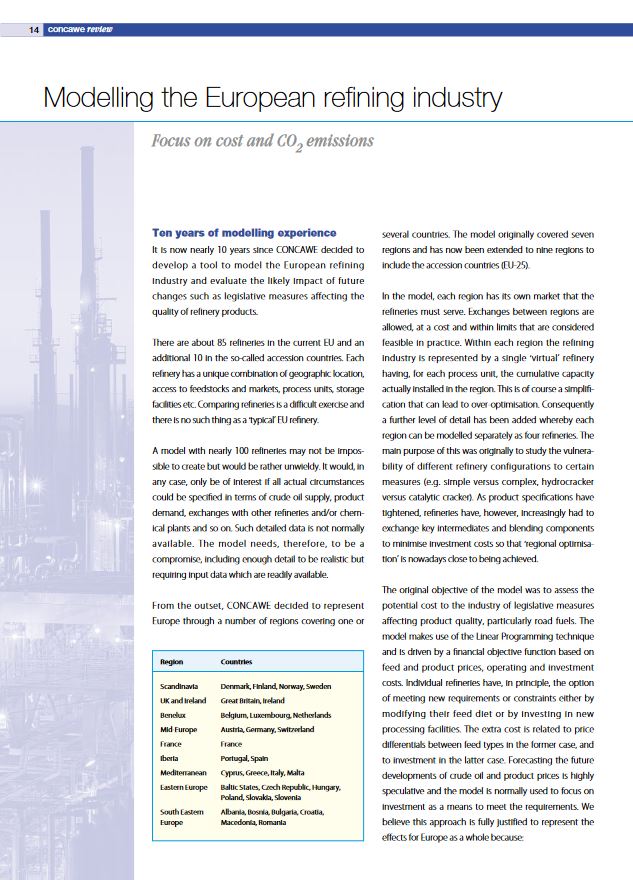
Ten years of modelling experience It is now nearly 10 years since CONCAWE decided to develop a tool to model the European refining industry and evaluate the likely impact of future changes such as leg...
Concawe Reviews
Occupational exposures to gasoline vapour
The risk assessment methodology requires data on exposure in order to make comparisons between so-called ‘no-effect-levels’, arising from health effect studies, and exposure cases as they occur...
Concawe Reviews
Oil in water analysis
The determination of the oil content of refinery effluent water has long been a subject of studies. CONCAWE first published a report on oil in water analysis in 1972.
Although we all know what â...
Concawe Reviews
Sulphur-free fuels are on the way
The final version of the revised EU Fuels Directive, 2003/17/EC, was published in March 2003. As expected, sulphur-free gasoline and diesel fuels (10 mg/kg maximum sulphur content), must be availab...
Concawe Reviews
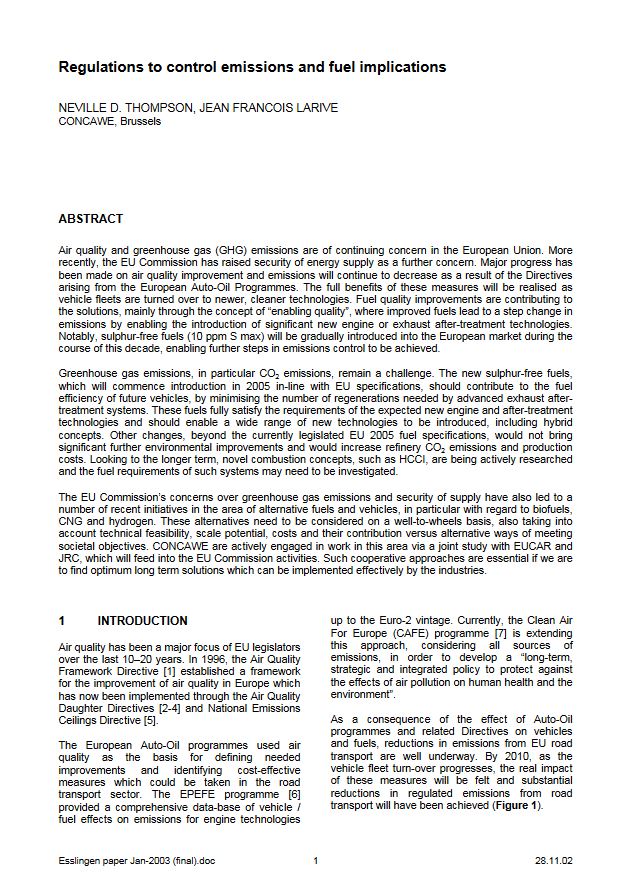
Regulations to control emissions and fuel implications
Air quality and greenhouse gas (GHG) emissions are of continuing concern in the European Union. More recently, the EU Commission has raised security of energy supply as a further concern. Major progr...
Concawe Reviews
CONCAWE Review – Autumn 2002
Volume 11 • Number 2: Those old enough to remember the ’70s may have a sense of déjà vu as energy conservation appears once more at the forefront. Today, however, in addition to depletion of nat...
Concawe Reviews
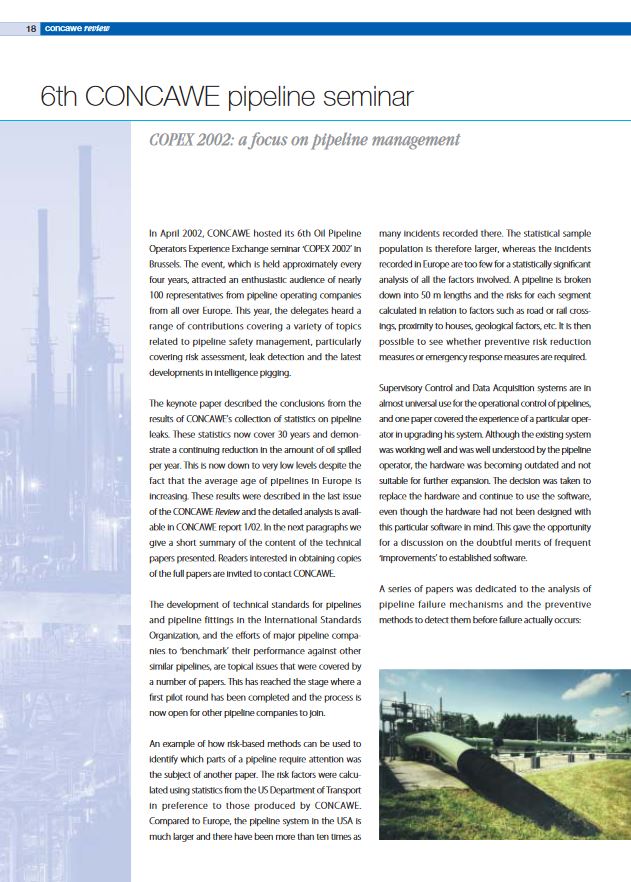
6th CONCAWE pipeline seminar
In April 2002, CONCAWE hosted its 6th Oil Pipeline Operators Experience Exchange seminar ‘COPEX 2002’ in Brussels. The event, which is held approximately every four years, attracted an enthusiasti...
Concawe Reviews
AIRNET
AIRNET is the acronym for the Thematic Network on Air Pollution and Health.
The Network has been funded by the Commission’s DG Research to help with the interpretation of results of European r...
Concawe Reviews
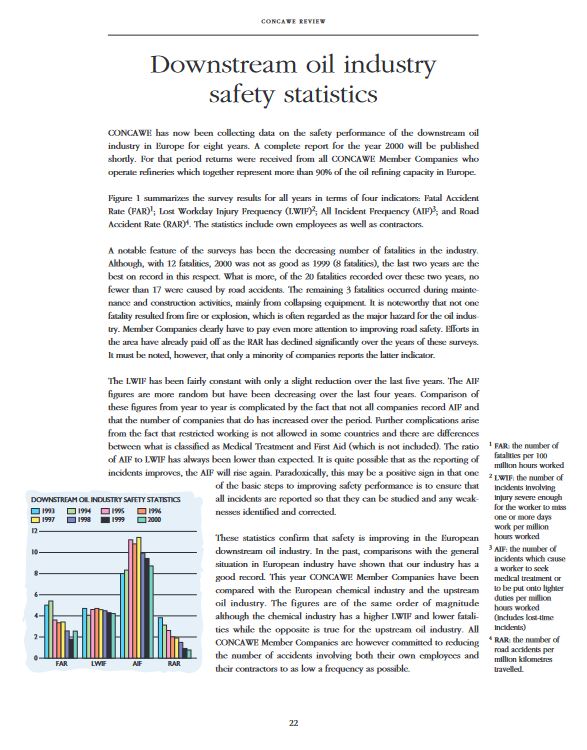
Downstream oil industry safety statistics
CONCAWE has now been collecting data on the safety performance of the downstream oil industry in Europe for eight years.
A complete report for the year 2000 will be published shortly. For that pe...
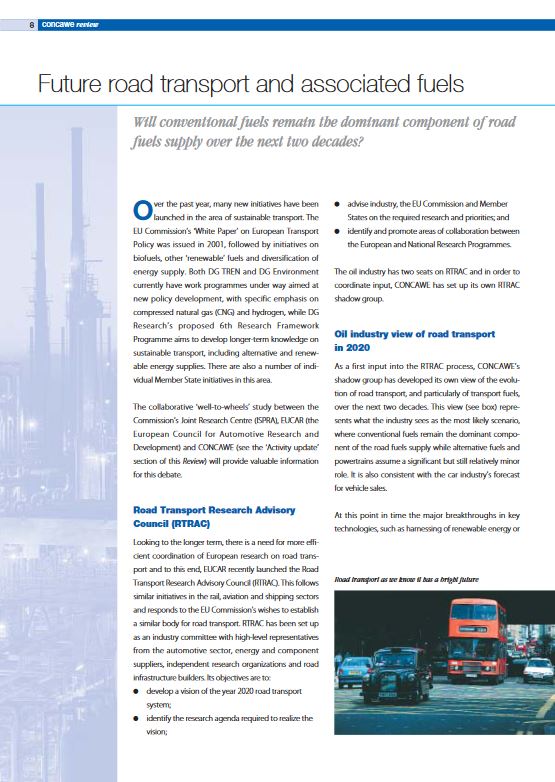
Concawe Reviews
Future road transport and associated fuels
Over the past year, many new initiatives have been launched in the area of sustainable transport. The EU Commission’s ‘White Paper’ on European Transport Policy was issued in 2001, followed b...
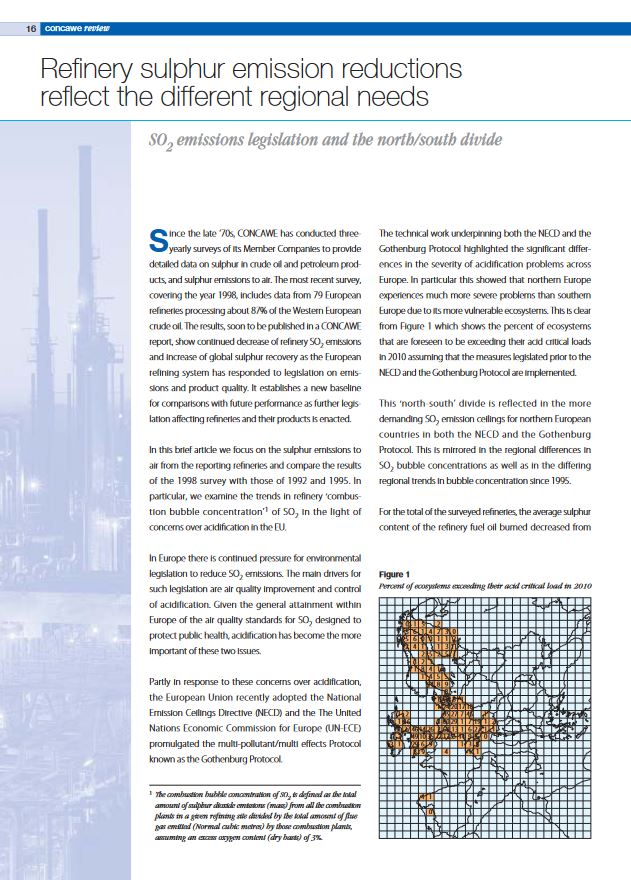
Concawe Reviews
Refinery sulphur emission reductions reflect the different regional needs
Since the late ’70s, CONCAWE has conducted three yearly surveys of its Member Companies to provide detailed data on sulphur in crude oil and petroleum products, and sulphur emissions to air. The mos...
Concawe Reviews
The focus on aromatics in automotive fuels specifications
Over the years, and particularly in the past decade, European motor fuel specifications have changed dramatically. This has followed a general trend, supported mainly by concerns about the effect o...
Concawe Reviews
CONCAWE Review – Spring 2002
Volume 11 • Number 1: The CONCAWE Review has now been published for 10 years. While content is what really matters and gets all our attention, we are aware that presentation plays its role, hence th...
Concawe Reviews
Biofuels
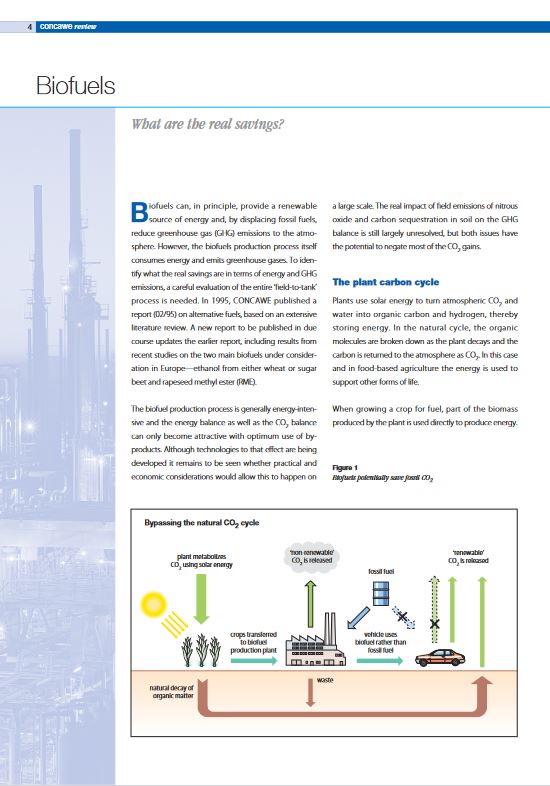
Biofuels can, in principle, provide a renewable source of energy and, by displacing fossil fuels, reduce greenhouse gas (GHG) emissions to the atmosphere. However, the biofuels production process i...
Concawe Reviews
Emissions from modern diesel engines
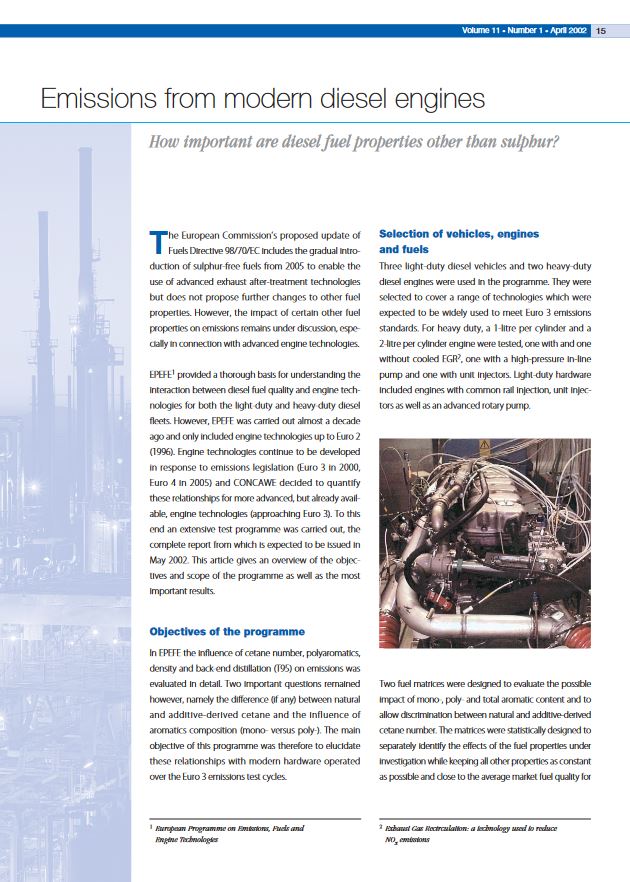
The European Commission’s proposed update of Fuels Directive 98/70/EC includes the gradual introduction of sulphur-free fuels from 2005 to enable the use of advanced exhaust after treatment technolo...