
Concawe Review
Concawe Reviews
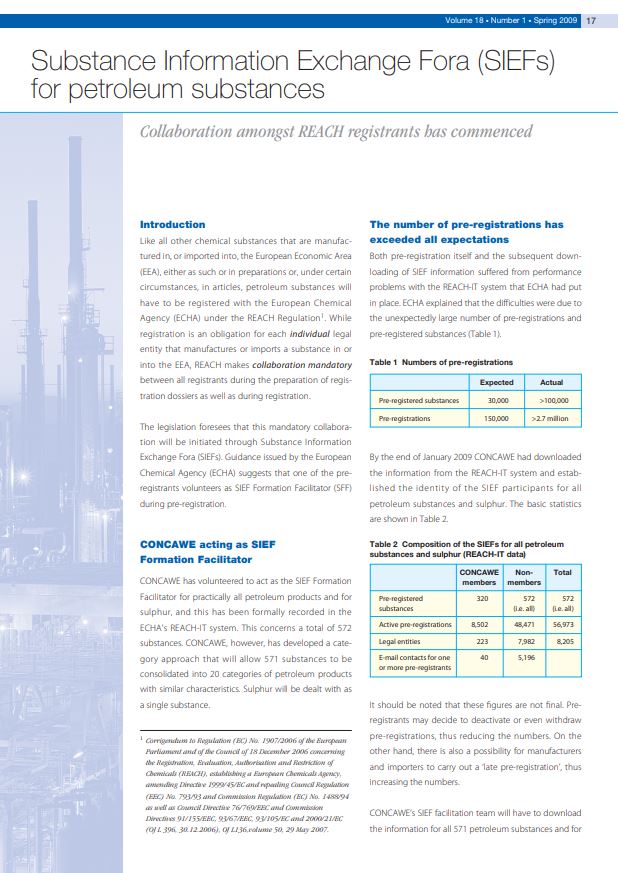
Substance Information Exchange Fora (SIEFs) for petroleum substances
Like all other chemical substances that are manufacture in, or imported into, the European Economic Area (EEA), either as such or in preparations or, under certain circumstances, in articles, petr...
Concawe Reviews
The footprint of petroleum fuels
There are various circumstances, in particular in the context of life cycle analyses (LCA) where it may be desirable to establish the footprint of fossil fuels in terms of cost, energy or greenhous...
Concawe Reviews
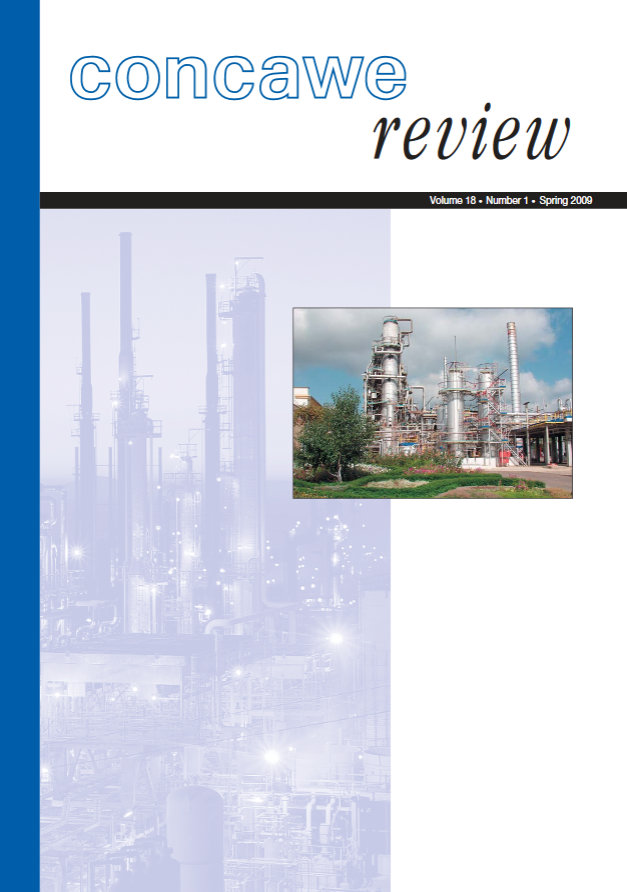
CONCAWE Review – Spring 2009
Volume 18 • Number 1: When Concawe's director joined CONCAWE in late 2004, he took the helm of an organisation which had already proved its value to the oil industry through more than 40 years of te...
Concawe Reviews
Downstream oil industry safety statistics
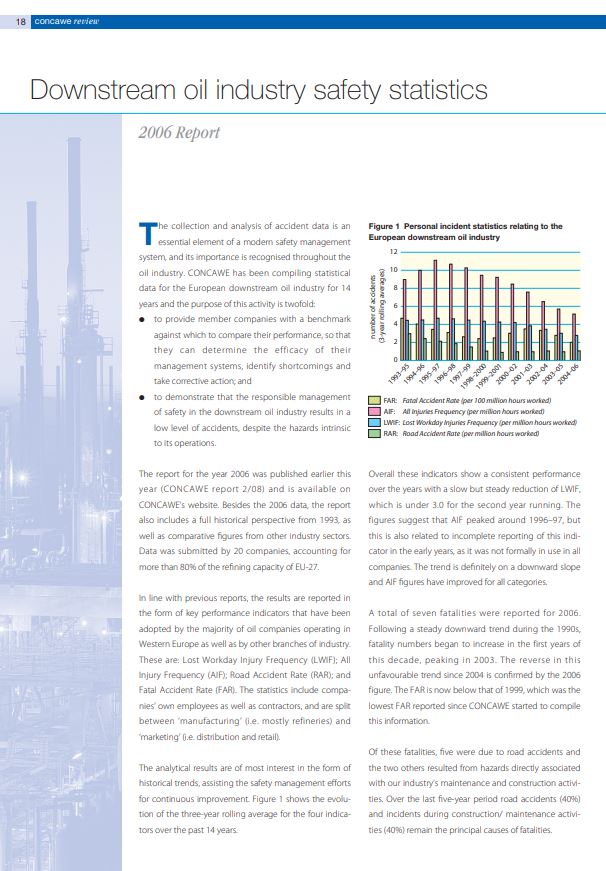
The collection and analysis of accident data is an essential element of a modern safety management system, and its importance is recognised throughout the oil industry.
CONCAWE has been compilin...
Concawe Reviews
Performance of European cross-country oil pipelines
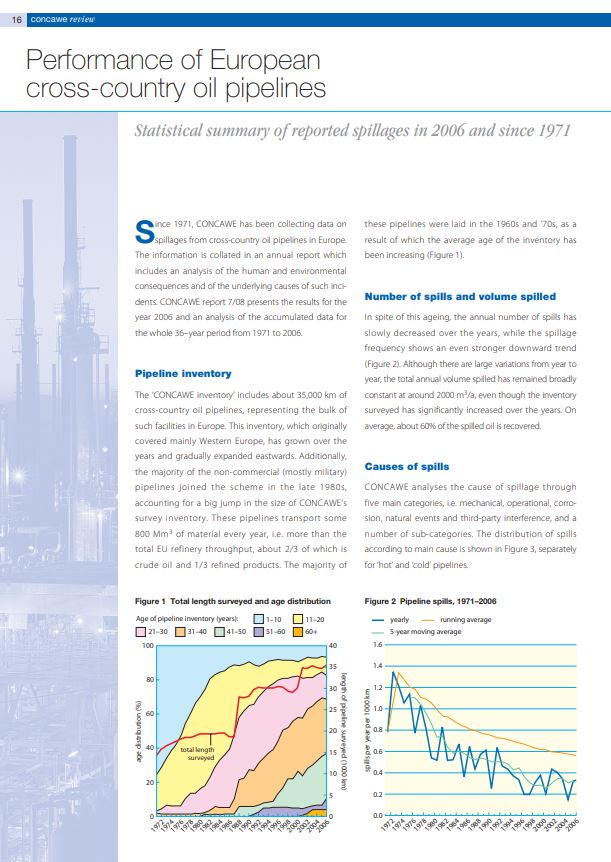
Since 1971, CONCAWE has been collecting data on spillages from cross-country oil pipelines in Europe. The information is collated in an annual report which includes an analysis of the human and enviro...
Concawe Reviews
Reducing the sulphur content of marine fuels
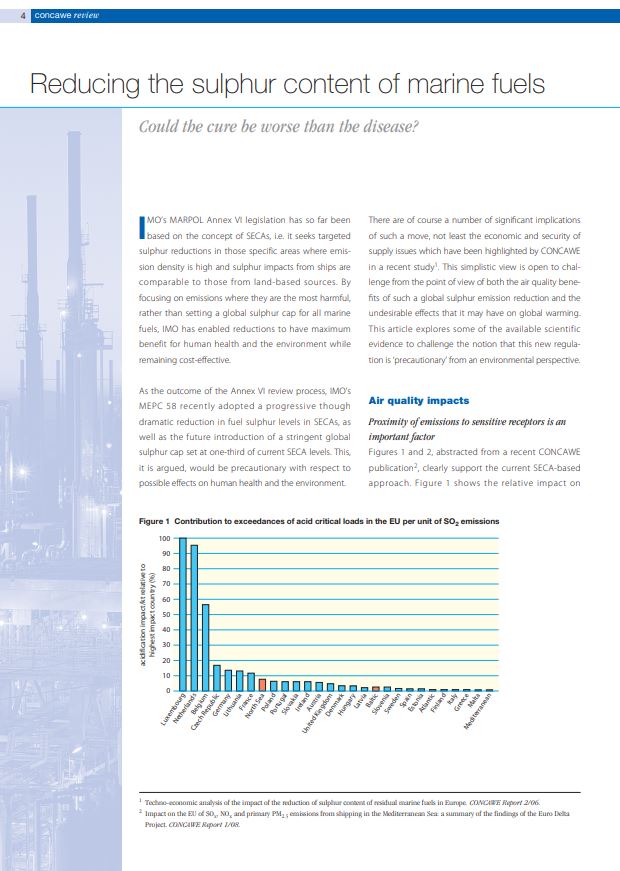
IMO’s MARPOL Annex VI legislation has so far been based on the concept of SECAs, i.e. it seeks targeted sulphur reductions in those specific areas where emission density is high and sulphur impac...
Concawe Reviews
CONCAWE Review – Autumn 2008
Volume 17 • Number 2: The implementation process of the REACH legislation is fast approaching the registration phase. CONCAWE is working hard with its members to prepare the registration dossiers, a...
Concawe Reviews
Advanced combustion engines for low emissions and high efficiency
Air pollutant emissions from motor vehicles have fallen dramatically over the past two decades as a result of continuing improvements in engine and after treatment technologies to meet lower regulated...
Concawe Reviews
Particle emissions from modern vehicles
Ultra-low sulphur fuels have enabled the introduction of modern engine and after-treatment technologies in order to meet increasingly stringent exhaust emissions limits. Through these improvements,...
Concawe Reviews
Advanced combustion engines for low emissions and high efficiency
European road traffic has increased dramatically over the past several decades and the same growth is now being seen in many other parts of the world. This increased demand has brought new challeng...
Concawe Reviews
CO2 emissions from EU refineries
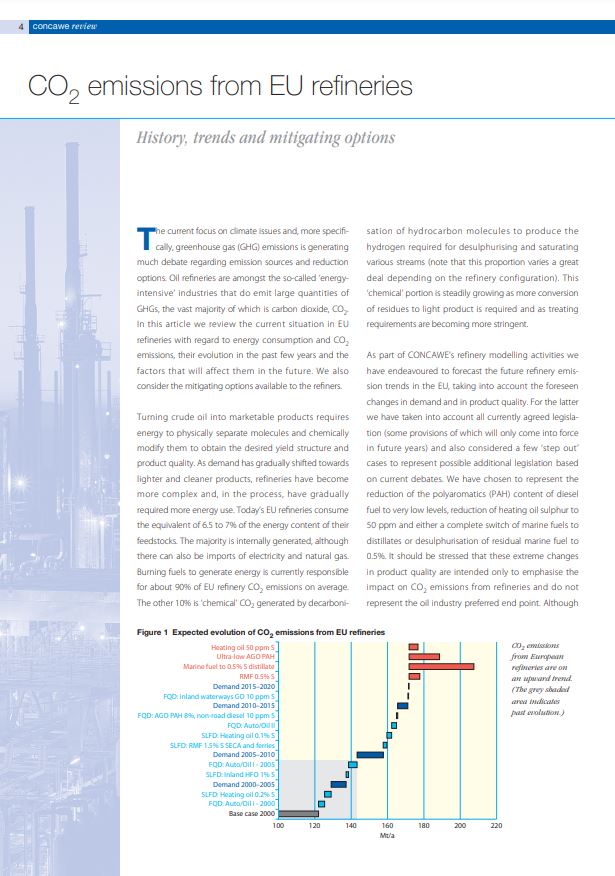
The current focus on climate issues and, more specifically, greenhouse gas (GHG) emissions is generating much debate regarding emission sources and reduction options. Oil refineries are amongst the so...
Concawe Reviews
Cost-benefit analysis and air quality policy
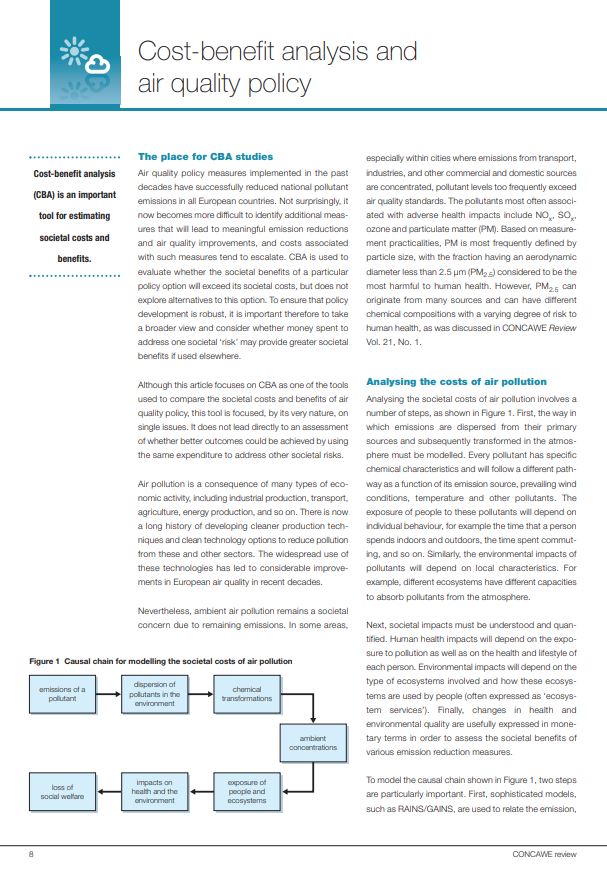
Air quality policy measures implemented in the past decades have successfully reduced national pollutant emissions in all European countries. Not surprisingly, it now becomes more difficult to identif...
Concawe Reviews
Cost-benefit analysis for air quality policies
An article published in CONCAWE Review Vol. 15, No. 2, described the methodology for assigning a monetary value to the effects of air pollution on human health. In the present article we briefly re...
Concawe Reviews
Mandatory collaboration of all registrants under REACH
Under the new REACH Regulation1 all chemical substances will have to be registered with the European Chemical Agency (ECHA).
This includes petroleum substances that are manufactured in, or impor...
Concawe Reviews
The Integrated Pollution Prevention and Control (IPPC) Directive
In the Autumn of 2005, during the preparatory work by DG Environment to revise the current Integrated Pollution Prevention and Control (IPPC) Directive, CONCAWE published the results of a small but im...
Concawe Reviews
CONCAWE Review – Spring 2008
Volume 17 • Number 1: Earlier this year, CONCAWE became aware of a discussion around the status of gasoline under the REACH legislation. This discussion could have led to a momentous change that wou...
Concawe Reviews
The compliance challenge from measuring PM10 concentrations
The First Air Quality Daughter Directive (1999/30/EC) establishes limit values for ambient concentrations of sulphur dioxide, nitrogen dioxide and oxides of nitrogen, particulate matter (PM10) and lea...
Concawe Reviews
The European Pollutant Release and Transfer Register
The European Pollutant Release and Transfer Register Regulation (E-PRTR) came into force on 24 February 2006, replacing the European Pollutant Emission Register (EPER) Decision....
Concawe Reviews
The future composition of the EU road fuel pool
The transport sector in general, and particularly road transport, is the focus of much attention at the moment. Demand for mobility keeps increasing, driving up demand for both vehicles and fuels, whi...
Concawe Reviews
CONCAWE Review – Autumn 2007
Volume 16 • Number 2: Environmental issues are, in many ways, at the heart of public concerns today. Quite naturally CONCAWE gets involved in these issues and brings its contribution in a variety of...
Concawe Reviews
Assessing the environmental sensitivity of petrol filling station locations across Europe
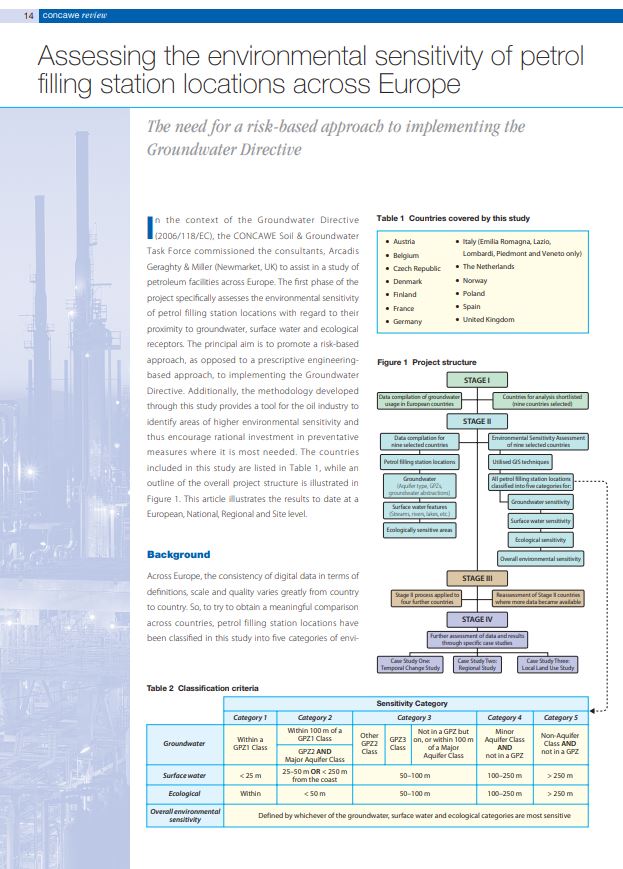
In the context of the Groundwater Directive (2006/118/EC), the CONCAWE Soil & Groundwater Task Force commissioned the consultants, Arcadis Geraghty & Miller (Newmarket, UK) to assist in a stud...
Concawe Reviews
Human biomonitoring
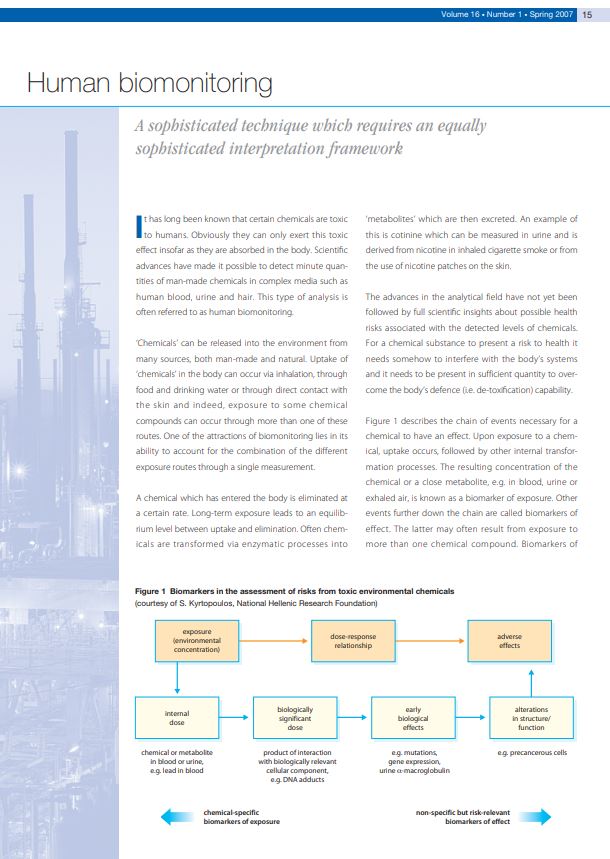
It has long been known that certain chemicals are toxic to humans. Obviously they can only exert this toxic effect insofar as they are absorbed in the body.
Scientific advances have made it poss...
Concawe Reviews
New ship emissions inventory for the Mediterranean Sea
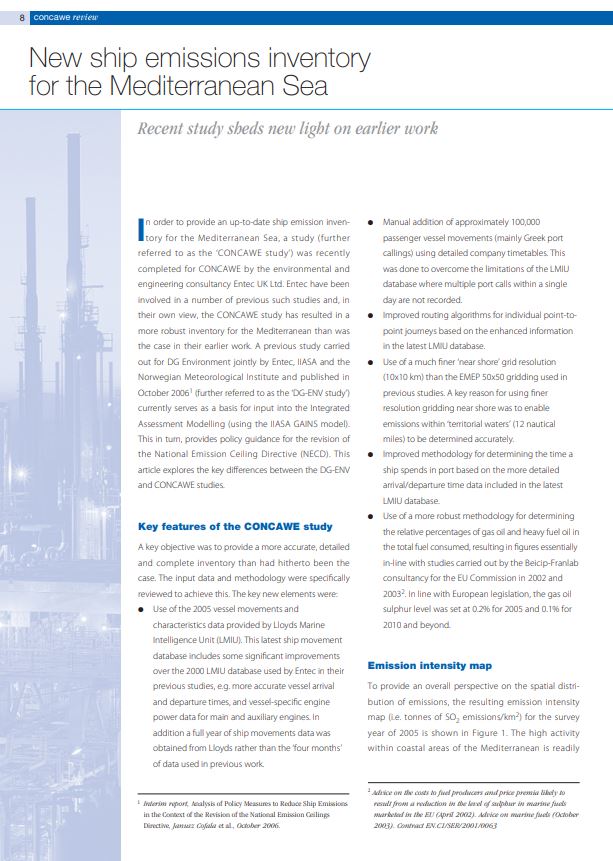
In order to provide an up-to-date ship emission inventory for the Mediterranean Sea, a study (further referred to as the ‘CONCAWE study’) was recently completed for CONCAWE by the environmental...
Concawe Reviews
Switching world shipping to marine diesel?
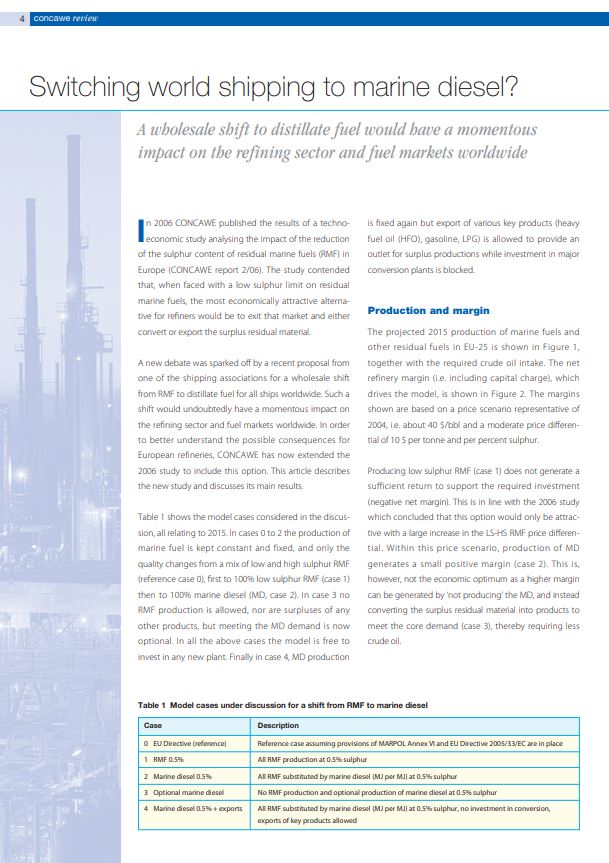
In 2006, CONCAWE published the results of a techno-economic study analysing the impact of the reduction of the sulphur content of residual marine fuels (RMF) in Europe (CONCAWE report 2/06).
The st...