
Concawe Review
Concawe Reviews
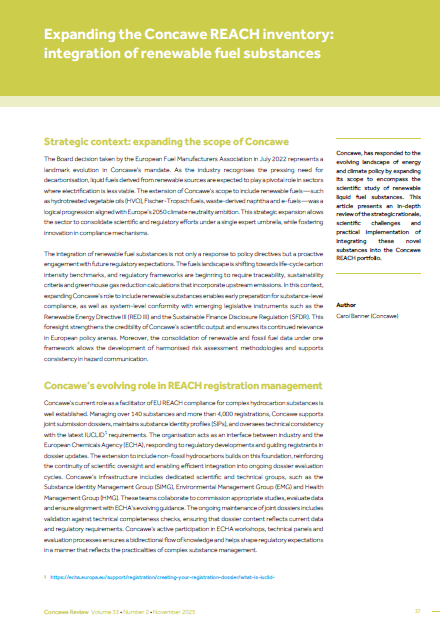
Expanding the Concawe REACH inventory: integration of renewable fuel substances
Concawe Review 33.2 Special REACH Edition - Article 5
The European Fuel Manufacturers Association (EFMA), through its scientific division Concawe, has responded to the evolving landscape of energy...
Concawe Reviews
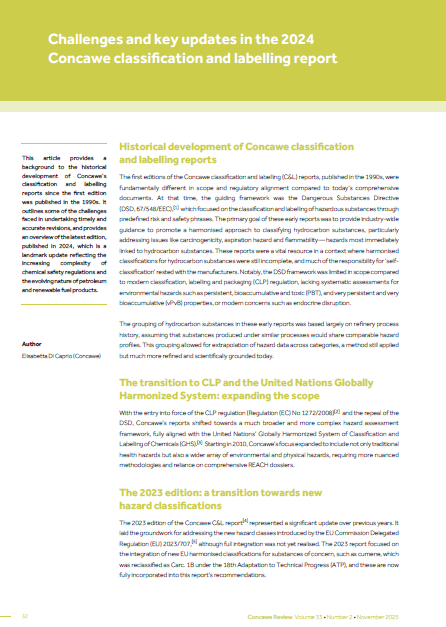
Challenges and key updates in the 2024 Concawe classification and labelling report
Concawe Review 33.2 Special REACH Edition - Article 4
The 2024 edition of the Concawe classification and labelling report delivers a substantial update to the hazard classification and labelling re...
Concawe Reviews
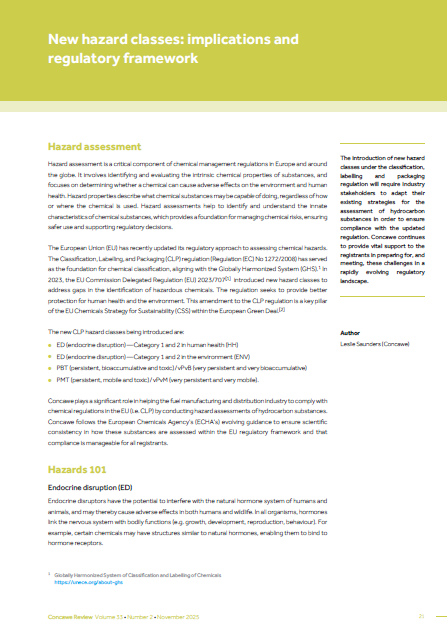
New hazard classes: implications and regulatory framework
Concawe Review 33.2 Special REACH Edition - Article 3
Hazard assessment is a critical component of chemical management regulations, serving to identify substance properties that may pose risks to...
Concawe Reviews
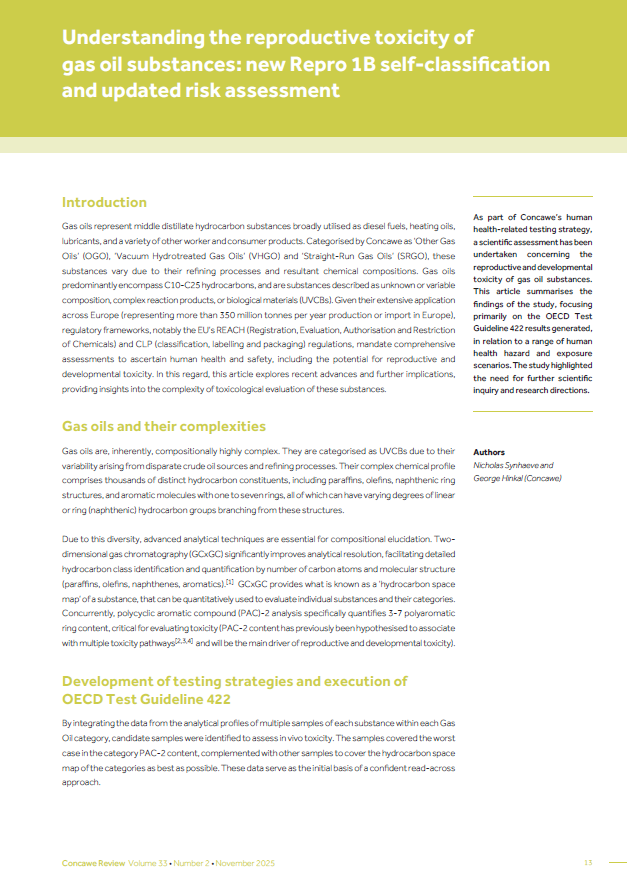
Understanding the reproductive toxicity of gas oil substances: new Repro 1B self-classification and updated risk assessment
Concawe Review 33.2 Special REACH Edition - Article 2
This article synthesises the scientific findings and REACH dossier developments concerning a reproductive and developmental toxicity assessment...
Concawe Reviews
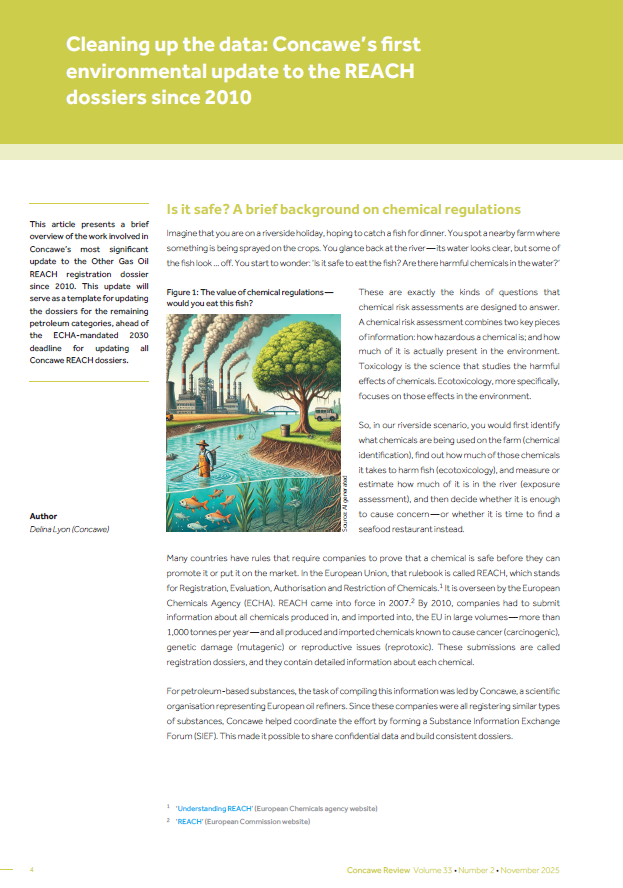
Cleaning up the data: Concawe’s first environmental update to the REACH dossiers since 2010
Concawe Review 33.2 Special REACH Edition - Article 1
In January 2025, Concawe distributed the Other Gas Oil (OGO) REACH (Registration, Evaluation, Authorisation and Restriction of Chemicals) regis...
Concawe Reviews
Concawe Review 33.2 – Special REACH Edition
Compliance with the requirements of REACH and the classification, labelling and packaging (CLP) regulation is essential for the licence to operate, and to be able to produce and sell petroleum product...
Concawe Reviews
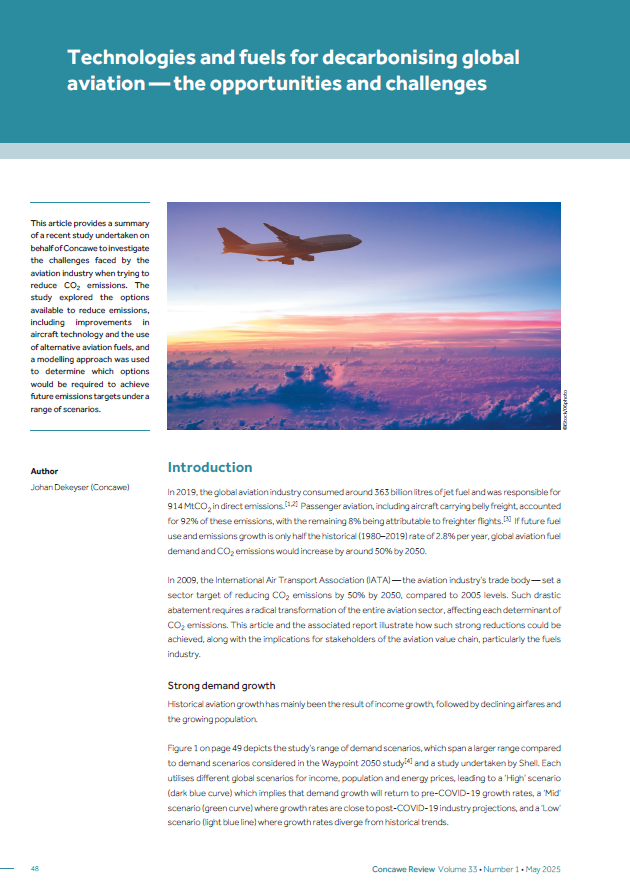
Technologies and fuels for decarbonising global aviation—the opportunities and challenges
This article provides a summary of a ‘deep dive’ study into the opportunities and challenges associated with the decarbonisation of the aviation industry. The study is part of Concawe’s Low Carb...
Concawe Reviews
HDV CO₂ Comparator—a life-cycle assessment tool for heavy-duty vehicles in real-world conditions
This article summarises a study to create a life-cycle assessment tool for heavy-duty vehicles. Users are provided with an easy-to-use interactive tool on the Concawe website to compare the CO₂ in...
Concawe Reviews
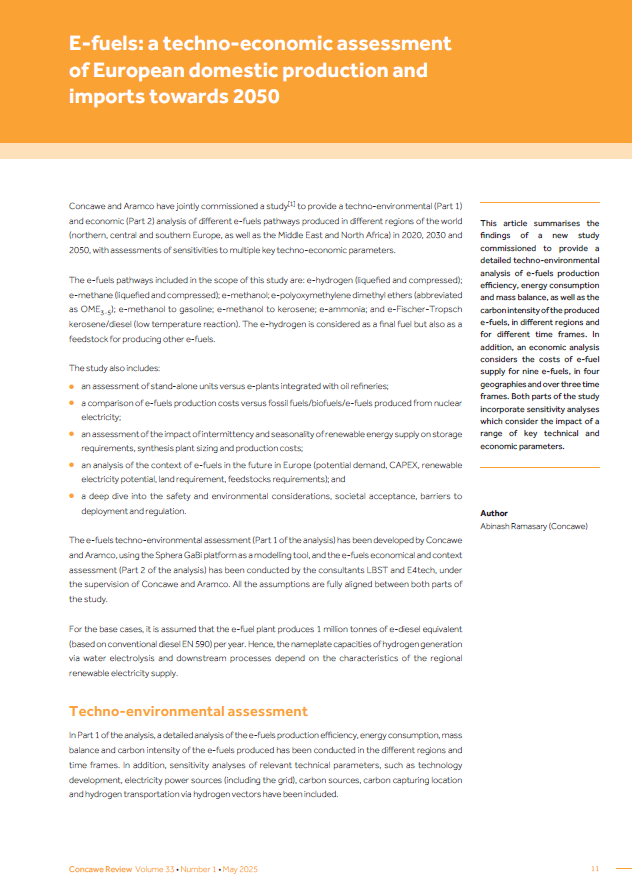
E-fuels: a techno-economic assessment of European domestic production and imports towards 2050
This updated study presents a twofold analysis — techno-environmental and economical — of the different e-fuels production pathways in Europe (northern, central and southern Europe), and the Middl...
Concawe Reviews
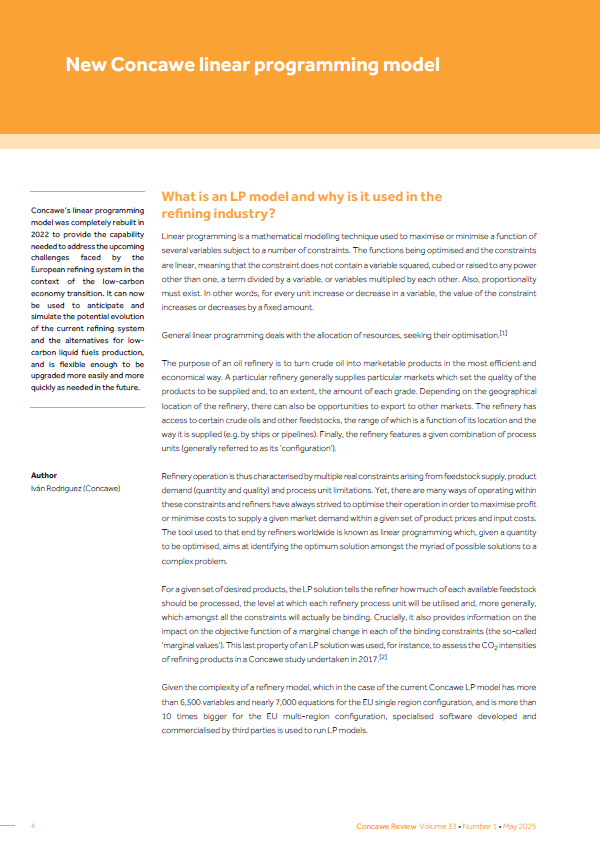
New Concawe linear programming model
The production of liquid fuels in Europe is evolving to embrace the low-carbon economy transition as presented by the European Commission (‘Fit for 55’, ‘EU Green deal’, etc.). Therefore, a fl...
Concawe Reviews
Concawe Review 33.1
I am pleased to introduce this new edition of the Concawe Review, which focuses mainly on topics related to the potential contribution of the fuel manufacturing industry and the role of liquid fuels t...
Concawe Reviews
Concawe Review 32.2 – Special Air Quality Edition
This Review is focused on air quality.
The first and third articles in this Review summarise studies conducted in collaboration with TNO, which analyse the influence that some sectors have on the a...
Concawe Reviews
The impact of aviation emissions on urban air quality in Europe – An airport/city analysis
This article presents results from a modelling study carried out to assess the influence that aviation emissions have on air quality in Europe. Using a 3-D chemical transport model (LOTOS-EUROS) and i...
Concawe Reviews
Atlas of Ozone chemical regimes in Europe
While concentrations of most air pollutants have been decreasing in Europe over the past 20 years, ozone (O3 ) is showing variable trends, with increasing average concentrations and decreasing peak on...
Concawe Reviews
The impact of shipping emissions on urban air quality in Europe – A port/city analysis
This article presents results from a modelling study carried out to assess the influence that shipping emissions have on the air quality in European port cities. Using a 3-D chemical transport model (...
Concawe Reviews
The Concawe LNAPL Toolbox
The Concawe LNAPL Toolbox is a web-based tool that provides essential information to the LNAPL remediation community. LNAPL, or light non-aqueous phase liquids, are typically historic hydrocarbon rele...
Concawe Reviews
Revising EU ambient air quality standards—the implications for compliance in Europe towards 2050
This article presents the results of a modelling study carried out to examine how concentrations of key air pollutants (i.e. nitrogen dioxide (NO2), particulate matter (PM) and ozone (O3)) would vary...
Concawe Reviews
Evaluation of plug-in hybrid vehicles in real-world conditions by simulation and their contribution to mitigating greenhouse gas emissions in a battery-constrained environment
Assessing the real-world energy performance and emissions of plug-in hybrid electric vehicles (PHEVs) is complex: it depends on their usage (trip distance, recharging behaviour), which results in diff...
Concawe Reviews
Biodiversity impact assessment of future biomass provision for biofuel production
Restoring and preserving biodiversity is widely acknowledged as crucial in the mobilisation of biofeedstocks for biofuels. Following Concawe’s joint study with Imperial College Consultants on the po...

Concawe Reviews
Concawe Review 32.1
As the September 2023 edition of the Concawe Review was being finalised, a number of reports discussed the decrease in the biodiversity of the planet. Because the biodiversity contained in different e...

Concawe Reviews
Concawe Review Special REACH
Following the REACH registration phase, ECHA began the substances evaluation phase in 2012. The proof of similarity and subsequent justification of read-across between Concawe’s substances, which is...
Concawe Reviews
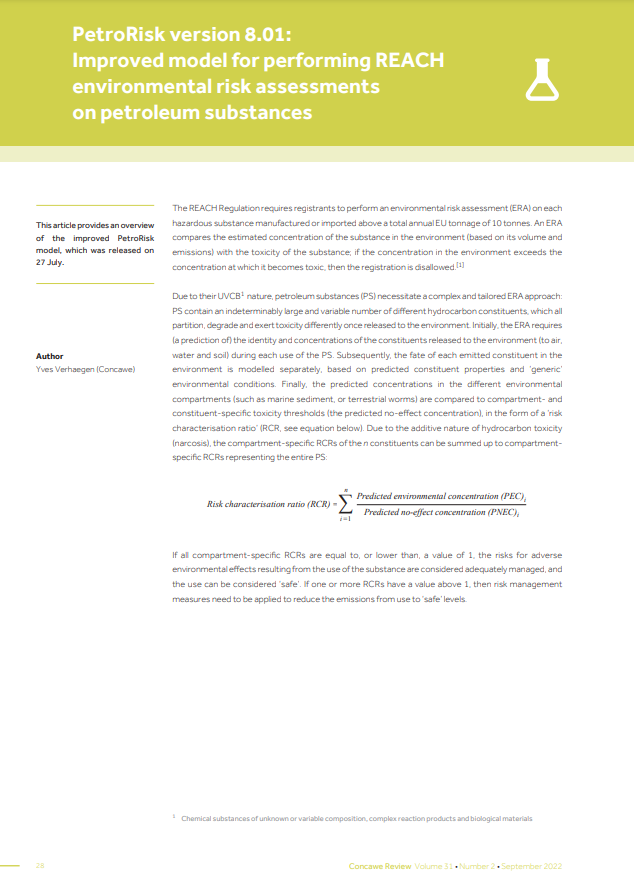
PetroRisk version 8.01: Improved model for performing REACH Environmental Risk Assessments on petroleum substances
Concawe has updated the PetroRisk model used to calculate the environmental risk assessments (ERAs) for petroleum substances needed for REACH registration dossiers. The updates result in a model which...
Concawe Reviews
A novel approach for assessing the biodegradability of constituents in petroleum substances
Petroleum substances contain hundreds to thousands of constituents, making it very difficult to generate biodegradation data on all of those constituents individually.
Concawe is undertaking a nove...
Concawe Reviews
Generation of biodegradability data on petroleum constituents using enhanced tests (OECD guideline 301 F)
To improve the persistence assessment of petroleum substances, Concawe started a testing programme for several hydrocarbons. Ready biodegradability tests were proposed on six 3-ring polycyclic aromati...