With the publication of CONCAWE report 5/05 an extensive work programme on the factors potentially affecting the hearing of petroleum industry workers has recently been completed by the CONCAWE Health Management Group. It was initiated some seven years ago when it...
Air pollution is a major issue in an increasing number of megacities around the world, and new policies to address urban air pollution are likely to be enacted in many developing countries irrespective of the participation of these countries in any explicit future...
The ‘Clean Air For Europe’ (CAFE) programme, carried out over the past three years by the EU Commission’s DG Environment, has resulted in the recent publication of the ‘Thematic Strategy on Air Pollution’ (TSAP) which provides a ‘road map’ for the review of existing...
Volume 14, number 2: 2005 has been a year of positive developments for CONCAWE. Through its heavy involvement in the development of the CAFE programme and in the Fuels Directive review process, our Association has confirmed its established reputation as a professional...
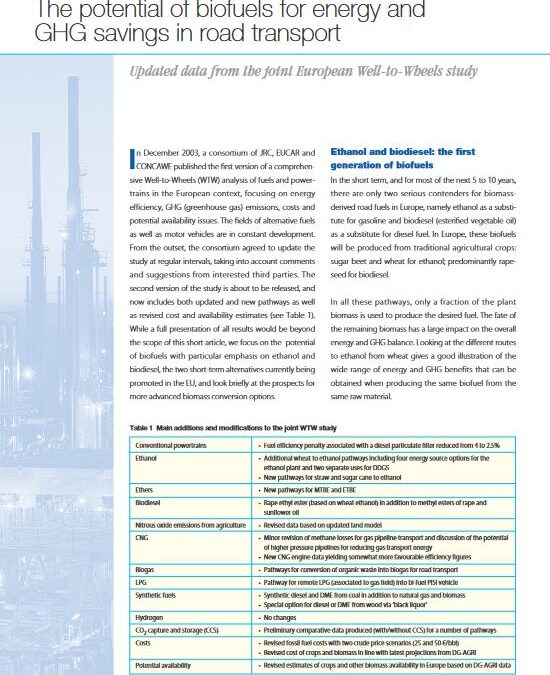
In December 2003, a consortium of JRC, EUCAR and CONCAWE published the first version of a comprehensive Well-to-Wheels (WTW) analysis of fuels and powertrains in the European context, focusing on energy efficiency, GHG (greenhouse gas) emissions, costs and potential...