Concawe
  • Home
  • About us
    • Who are we
    • Our Mission
    • Governance
    • Secretariat
    • Organisation & Structure
    • Membership
    • Vacancies
    • Videos
  • Publications
  • Topics
    • Environmental Impact
    • Health Impact
    • Products and Use
    • Fuel Manufacturing and Feedstocks
    • REACH
    • Safety
  • Maps
    • Refineries and Biorefineries Map
  • Tools
    • PETRORISK
    • PETROTOX
    • Concawe NO2 Viewer
    • Persistence Assessment Tool
    • The Hydrocarbon Biodegradation System-integrated Model
    • The Bioaccumulation Assessment Tool
    • Cars CO₂ Comparator
    • HDV CO₂ Comparator
  • Events
    • Upcoming Events
    • Past Events
  • Members Only
  • SIEF Space
  • Rate this website
Select Page
Estimating the CO2 intensities of EU refinery products: Statistical Regression Methodology

Estimating the CO2 intensities of EU refinery products: Statistical Regression Methodology

Jul 26, 2022

Report no. 15/22: This study aims at estimating the CO2 intensity of petroleum products at the gate of an average EU refinery (refining step of the production process, excluding upstream and downstream emissions) using a novel approach, which reconciles economic...
Fuel effects on modern diesel passenger car and commercial vehicle emissions (Concawe Review 31.1)

Fuel effects on modern diesel passenger car and commercial vehicle emissions (Concawe Review 31.1)

Jul 15, 2022

As both vehicle technology and emissions legislation continue to evolve, Concawe has conducted studies to examine the multidimensional effects that fuels can have on greenhouse gases (GHGs) and pollutant emissions from diesel passenger cars (PCs) and commercial...
How additional actions in the road transport sector could improve air quality in Europe — an extension of the Concawe urban air quality studies (Concawe Review 31.1)

How additional actions in the road transport sector could improve air quality in Europe — an extension of the Concawe urban air quality studies (Concawe Review 31.1)

Jul 15, 2022

This article presents results from a modelling study carried out to examine how concentrations of the major urban pollutants (i.e. nitrogen dioxide (NO2), particulate matter (PM) and ozone (O₃)) would vary under different emission reduction scenarios, and to assess...
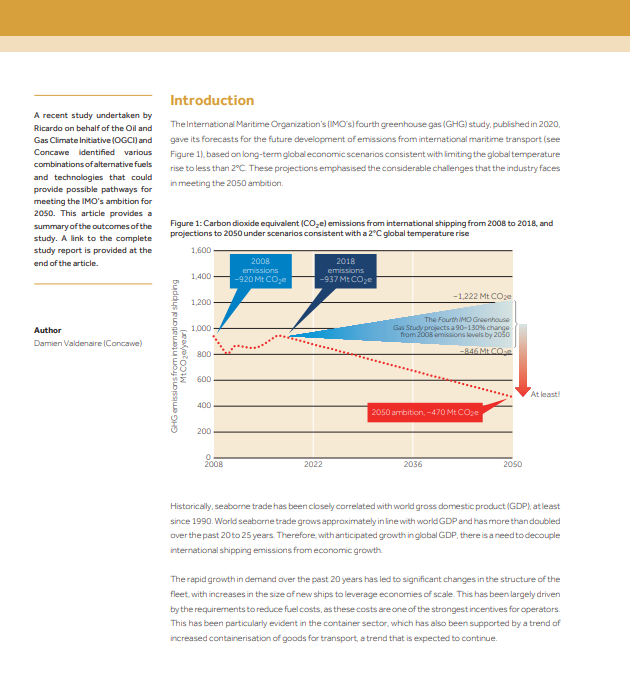
Technological, operational and energy pathways for maritime transport to reduce emissions towards 2050 (Concawe Review 31.1)

Technological, operational and energy pathways for maritime transport to reduce emissions towards 2050 (Concawe Review 31.1)

Jul 15, 2022

This article provides a summary of a ‘deep dive’ study into the future development of emissions from international maritime transport. The study is part of Concawe’s Low Carbon Pathways project, and has been undertaken by Ricardo on behalf of the Oil and Gas Climate...
Guidance on the compilation of Safety Data Sheets for Petroleum Products

Guidance on the compilation of Safety Data Sheets for Petroleum Products

Jun 29, 2022

Report no. 9/22: This Guidance addresses the specific Concawe recommendations for authoring of (extended) Safety Data Sheets for Unknown or Variable composition, Complex reaction products or of Biological materials (UVCB) petroleum substances, and mixtures containing...

Page 5 of 52«1234567891011121314151617181920...4050...»Last »

©CONCAWE 2026 – Disclaimer Privacy Policy Cookies Policy Terms of use Privacy Centre Competition Law Policy Guidelines Contact us

×