Report no. 10/12: This report describes primary biodegradation experiments performed to determine the persistence of higher molecular weight petroleum hydrocarbons in seawater. Results from the biodegradation experiments show that the majority of tested petroleum...
Report no. 7/12: The purpose of this report is to summarise the findings of the scientific and technical work undertaken by CONCAWE to assess the feasibility and potential benefit of characterising petroleum UVCB1 substances beyond the recommendations issued by...
Report no. 5/10: This report serves as an update to and an extension of a previous CONCAWE report on dermal absorption of petroleum hydrocarbons (Petroleum hydrocarbons:their absorption through and effects on the skin, CONCAWE Report 84/54, 1984). To contribute to...
Report no. 6/07: Information is presented on inhalation and dermal exposures to kerosine for workers in European manufacturing, distribution and aviation refuelling operations, for use in substance risk assessment according to EU regulations.
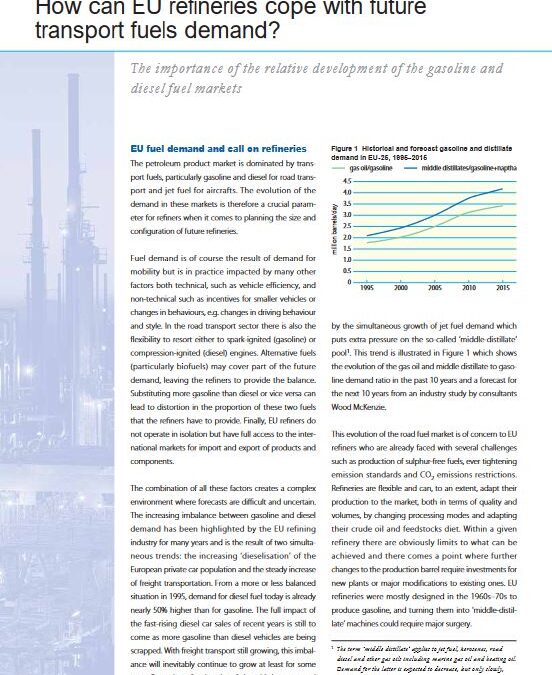
EU fuel demand and call on refineries The petroleum product market is dominated by transport fuels, particularly gasoline and diesel for road transport and jet fuel for aircrafts. The evolution of the demand in these markets is therefore a crucial parameter for...