Report no. 14/26: This eagerly anticipated study was launched in response to ongoing activities under the ‘European Aviation Fuel Standards Project’. The discussions here suggest that the composition of the fuel, mainly its sulphur, hydrogen, and aromatic (total...
Concawe Review 34.1 – Article 3: Aviation affects climate not only through CO2 emissions, but also through a range of short-lived non-CO2 effects. This article provides an overview of the main non-CO2 emissions from aircraft, including NOx, water vapour,...
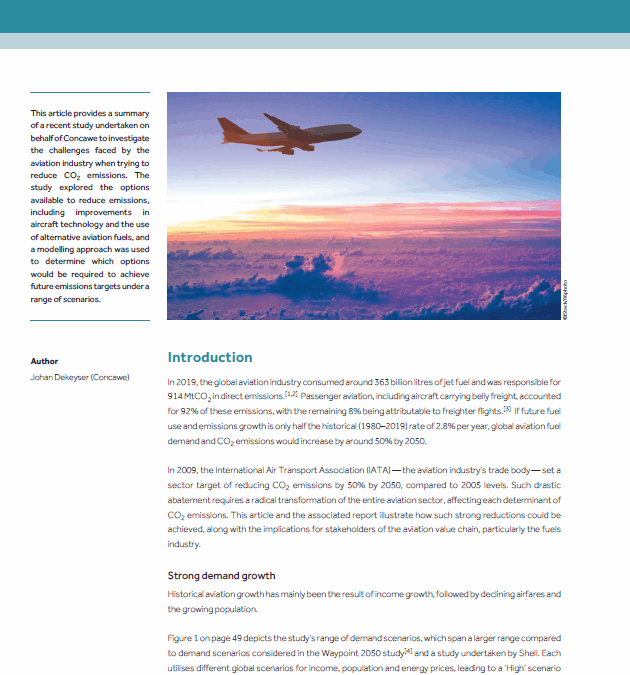
This article provides a summary of a ‘deep dive’ study into the opportunities and challenges associated with the decarbonisation of the aviation industry. The study is part of Concawe’s Low Carbon Pathways project, and has been undertaken by E4tech (UK) in partnership...
Report No. 01/24: The question of how aviation fuel composition affects the formation and lifetime of contrails is a complex one. Although the theory regarding initial contrail formation is well-founded in thermodynamics and proven to be correct by measurements, there...
Report no. 5/23: In 2019, the aviation sector directly employed 11.3 million people worldwide. If also accounting for the associated indirect, induced, and catalytic jobs, aviation enabled a total of 87.7 million jobs, which translates into a gross world product of...