Concawe
  • Home
  • About us
    • Who are we
    • Our Mission
    • Governance
    • Secretariat
    • Organisation & Structure
    • Membership
    • Vacancies
    • Videos
  • Publications
  • Topics
    • Environmental Impact
    • Health Impact
    • Products and Use
    • Manufacturing and Feedstocks
    • REACH
    • Safety
  • Maps
    • Refineries and Biorefineries Map
  • Tools
    • PETRORISK
    • PETROTOX
    • Concawe NO2 Viewer
  • Events
    • Upcoming Events
    • Past Events
  • Members Only
  • SIEF Space
  • Rate this website
Select Page
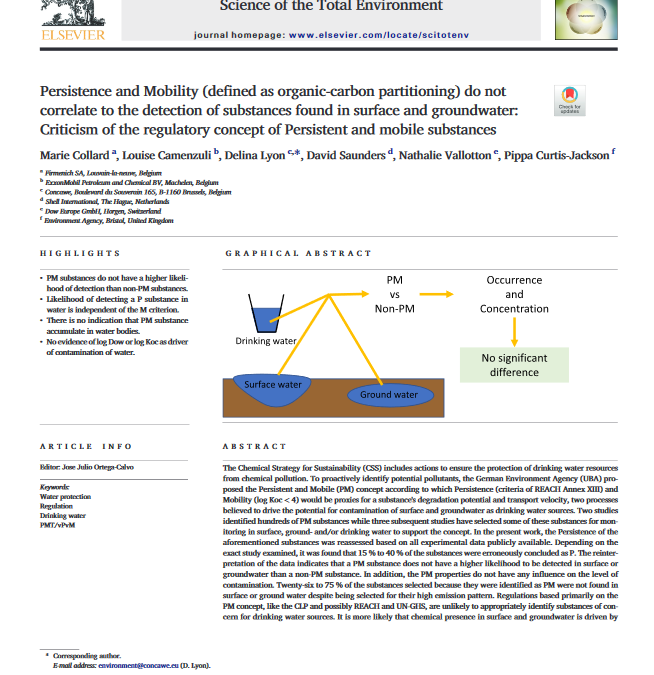
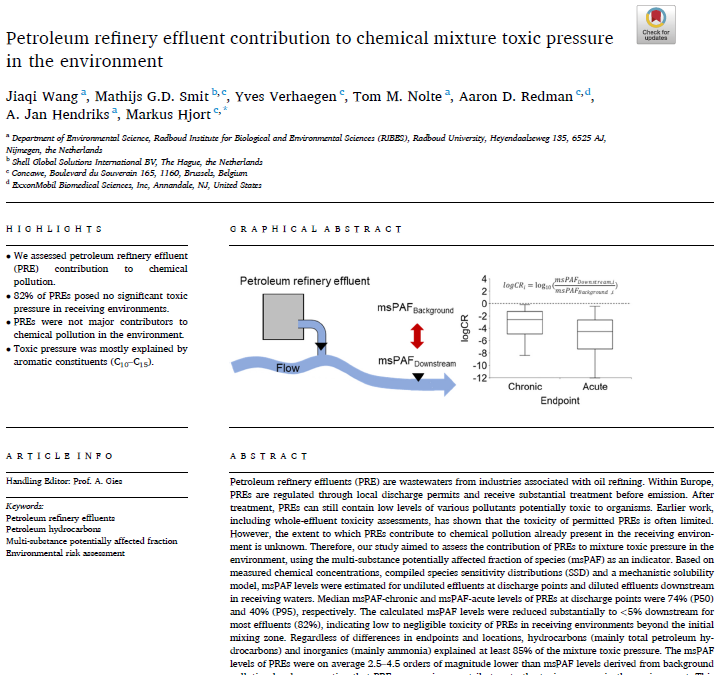
Petroleum refinery effluent contribution to chemical mixture toxic pressure in the environment

Petroleum refinery effluent contribution to chemical mixture toxic pressure in the environment

Nov 4, 2022

Petroleum refinery effluents (PRE) are wastewaters from industries associated with oil refining. Within Europe, PREs are regulated through local discharge permits and receive substantial treatment before emission. After treatment, PREs can still contain low levels of...
Assessment of Chemical Oxygen Demand/Total Organic Carbon (COD/TOC) ratios in refinery effluents

Assessment of Chemical Oxygen Demand/Total Organic Carbon (COD/TOC) ratios in refinery effluents

Sep 15, 2022

Report no. 16/22: Chemical Oxygen Demand (COD) analysis is one of the most commonly used analytical methods to indirectly measure organic pollutants in effluent waters. The standard COD methods use potassium dichromate which is restricted under the REACH regulation....
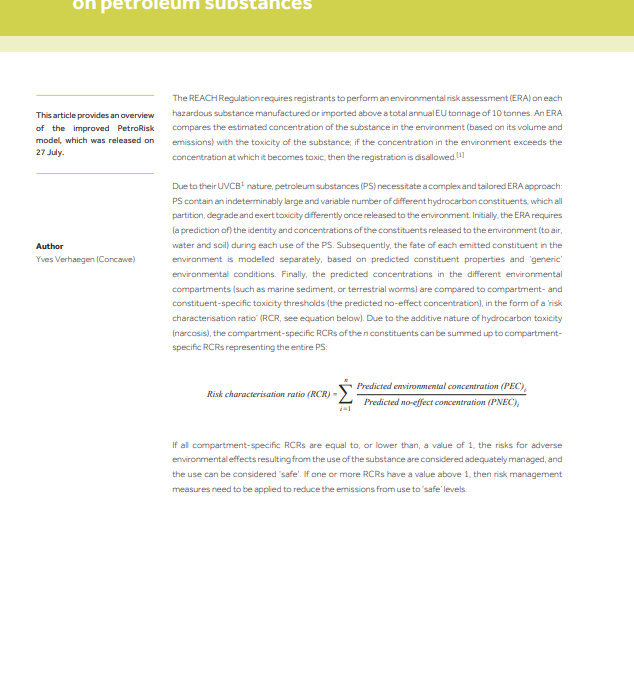
PetroRisk version 8.01: Improved model for performing REACH Environmental Risk Assessments on petroleum substances

PetroRisk version 8.01: Improved model for performing REACH Environmental Risk Assessments on petroleum substances

Sep 6, 2022

Concawe has updated the PetroRisk model used to calculate the environmental risk assessments (ERAs) for petroleum substances needed for REACH registration dossiers. The updates result in a model which is (1) faster, (2) more transparent, (3) better aligned with the...

A novel approach for assessing the biodegradability of constituents in petroleum substances

A novel approach for assessing the biodegradability of constituents in petroleum substances

Sep 6, 2022

Petroleum substances contain hundreds to thousands of constituents, making it very difficult to generate biodegradation data on all of those constituents individually. Concawe is undertaking a novel project with SINTEF—one of Europe’s largest independent research...
Generation of biodegradability data on petroleum constituents using enhanced tests (OECD guideline 301 F)

Generation of biodegradability data on petroleum constituents using enhanced tests (OECD guideline 301 F)

Sep 6, 2022

To improve the persistence assessment of petroleum substances, Concawe started a testing programme for several hydrocarbons. Ready biodegradability tests were proposed on six 3-ring polycyclic aromatic hydrocarbons (PAHs), in accordance with the OECD 301 F protocol....
Page 10 of 49«1234567891011121314151617181920...40...»Last »

©CONCAWE 2026 – Disclaimer Privacy Policy Cookies Policy Terms of use Privacy Centre Competition Law Policy Guidelines Contact us

×