Report no. 14/18: The European Commission (EC) is considering the use of “effect-based tools” (EBTs) for environmental monitoring as an alternative to, or in combination with, chemical analysis. In addition, there is interest in the use of passive sampler devices for...
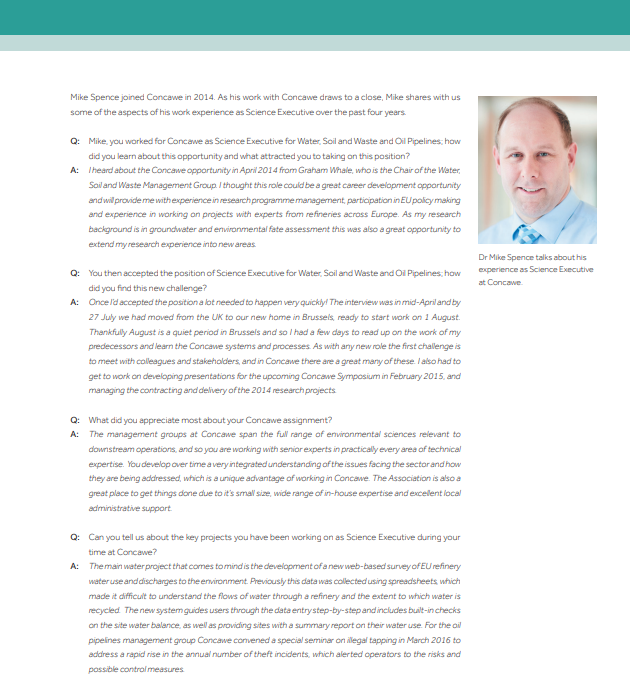
Mike Spence joined Concawe in 2014. As his work with Concawe draws to a close, Mike shares with us some of the aspects of his work experience as Science Executive over the past four years.
The health effects of benzene have been a major concern for regulators and health experts for many years. This has led to significantly lower regulatory threshold limits (such as occupational exposure limits, OELs) and the implementation of corresponding risk...
Report no. 2/18: This report provides an initial assessment of the extent to which toxicity testing is carried on European refinery effluents, and the types of test being used. The analysis is based on responses given to Concawe water use and effluent quality surveys...
Report no. 8/16: Aqueous Film Forming Foam (AFFF) and Fluoroprotein (FP)/ Film Forming Fluoroprotein Foam (FFFP) foam have been used since the 1960s and 1970s, respectively, for the suppression of class B (flammable liquid) fires at airports, refineries and other...