Today’s European air quality policy uses cost-benefit analysis (CBA) to assess the effectiveness of different measures to mitigate air pollution. This involves comparing the cost of achieving emission reductions with the benefits of reducing the concentrations...
The regulatory landscapeUnder the European Union’s Emissions Trading Scheme (ETS) Directive, industrial emitters of greenhouse gases (GHGs) must deliver emission permits or allowances every year that equal their actual GHG emissions for that year. In the first and...
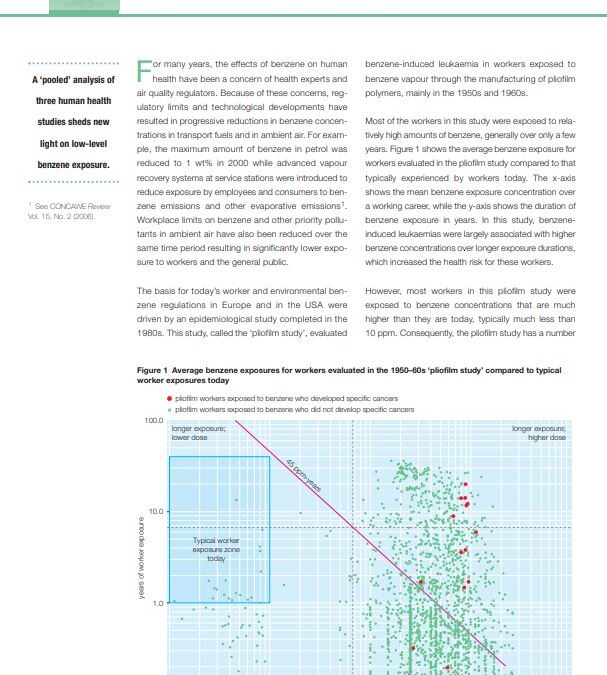
For many years, the effects of benzene on human health have been a concern of health experts and air quality regulators. Because of these concerns, regulatory limits and technological developments have resulted in progressive reductions in benzene concentrations in...
Welcome to the latest edition of the CONCAWE Review. As CONCAWE begins its 50th anniversary year in 2013, we continue to focus on high quality, scientifically objective research that is of value to our industry and to regulatory institutions. In this issue of the...
Report no. 7/12: The purpose of this report is to summarise the findings of the scientific and technical work undertaken by CONCAWE to assess the feasibility and potential benefit of characterising petroleum UVCB1 substances beyond the recommendations issued by...